| German 3, Semester I; Rechte und Pflichten |
 |
|
| Sections: Introduction | Stufe 1 | Stufe 2 | Stufe 3 | Grammatik | Verben | Wörterbuch |
| Stufe 3: Seite A | Seite B | Seite C | Seite D | |
 |
| Stufe 3, Seite B
Mach mit! Lernen wir neue Vokabeln mit dieser TPR-Aktivität. Dann mach das TPR-Quiz. 14 Punkte.
Even Germany had a close association with Elvis, Der König. In 1958 during his U.S. Army service, the King was stationed in Germany with the 32nd Tank Battalion in Friedberg, which now has an Elvis Presley Platz (square). In the nearby town of Bad Nauheim, about 22 miles north of Frankfurt, Elvis rented his own quarters at the Hotel Grünewald, in front of which today is a statue of Elvis. The surname Presley was actually Anglicized from the German name "Pressler" during the Civil War.
Although there is an American military presence yet in Germany, it has lessened over the last 20 years years. With the fall of the Berlin Wall in 1989 and the end of the Cold War, there was a downsizing of the number of United States’ aircrafts and personnel in Germany. Just recently in 2005, the Rhein-Main Air Base outside Frankfurt closed after having first been established in 1945 after WWII. Today, only Ramstein and Spangdahlem Air Bases remain as active U.S. air bases, supporting operations in the Middle East and Balkans.
Jetzt bist du dran! (Now it’s your turn!) Please choose from either Ramstein Air Base or Spangdahlem Air Base and answer the following questions for your teacher:
Here are some sites that you may want to check out: http://www.spangdahlem.af.mil Diese Aufgabe hat 10 Punkte.
The name Rammstein was taken indirectly from the German town of Ramstein in western Germany. In 1988 there was an airshow disaster at the Ramstein Air Base. Their signature song, Rammstein is a commemoration of this tragedy. They added an extra “m” to their name, which then translates literally in English to “ramming stone / battering ram.”
There is a group of masculine nouns (whose plural ends in –n) that has an –n on the end of the accusative, dative, and genitive singular forms as well. So they look like this:
Most of these are either very common words (Junge, Herr, Mensch, Nachbar) or foreign words borrowed into German which you will probably recognize (Pilot, Soldat, Student, Polizist). Tipp: If you see a masculine noun with a plural in –(e)n, it is almost certainly one of these weak nouns. Why do we call them “weak” nouns? Who knows, but it’s certainly a lot easier than saying “one of those masculine nouns that add an –n in all the singular forms except the nominative”! Oddballs: Of course there have to be a couple of “exceptions.” Both Name and Herz ( a das-word, that really does its own thing!) just can’t give up the added –s in the genitive, so they look like this in the singular:
Weiter: Stufe 3, Seite C | ||||||||||||||||||||||||
| © 2006 Aventa Learning. All rights reserved. |
 Lektion 3 Seite 3B
 Präsentation - Wohnung
 Kultureller Leckerbissen: Elvis Presley
 In 1958 Elvis Presley was stationed at a military base in Germany.
 Web search assignment
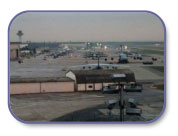 The former Rhein-Main Air Base outside Frankfurt.
 The German metal band “Rammstein”
 Vokabeltipp – Weak nouns