We're going to learn some new vocabulary, but before we do, let's switch gears a minute and make sure you understand the genitive. Do you remember? This is the new case we learned in Stufe 1. If you want to review before you do this assignment, go back to page 1E.
Now, here's the assignment. Give the German for the following phrases, all of which contain the genitive. Diese Aufgabe hat 12 Punkte.
the man's car
a child's dog
the woman's niece
my students' answers
during the day
because of the weather
Krankenversicherung
Germany is one of several countries around the world that provide a national health care system. Nearly all citizens are insured by a national health insurance (Krankenversicherung) program. Over 90 percent of all Germans receive health care through this program. Membership in this program is required for all those earning less than a specific income. This income ceiling changes periodically. The remainder of the population is covered through private for-profit insurance companies. Everyone, however, uses the same health care facilities.
Lernen wir etwas Neues!
Was sagt man, wenn es einem nicht gut geht? Was für Probleme gibt es, wenn es einem nicht gut geht? Lies weiter und lern etwas Neues! (Let's learn something new! What does one say when one doesn't feel well? What types of problems are there when one doesn't feel well? Read on and learn something new!)
Klicke auf das Bild um das Wort zu hören. Wiederhole was du horst. Dann klicke auf das Deutsche, um das Englische zu sehen. (Click on the picture to hear the word. Repeat it after you hear it. Then click on the German to see the English.)
Mir ist schlecht. Ich bin krank.
I am not well. I am sick.
Ich habe Fieber. Mir ist heiß.
I have a fever. I am hot.
Ich niese.
I sneeze.
Ich huste.
I cough.
Ich bin müde.
I am tired.
Ich habe Allergien.
I have allergies.
Ich habe eine Erkältung. Ich habe mich erkältet. Ich habe die Grippe.
I have a cold. I caught a cold. I have the flu.
Ich habe Durchfall. Ich habe Verstopfung.
I have diarrhea. I'm constipated.
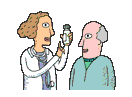
Die Ärztin gibt dem Patienten ein Rezept.
The doctor gives the patient a prescription.
Es gibt einen Notfall.
There is an emergency.
"Haben Sie etwas gegen...?" "Haben Sie etwas gegen Durchfall?"
Do you have something for . . .? Do you have something for diarrhea?
Der Arzt macht ihm einen Gipsverband.
The doctor makes him a cast.
Üben wir! Was passt zusammen? (Let's practice! What fits together?)
Üben wir diese Vobalen mit einem Kreuzworträtsel
Deine ganze Familie ist krank! Schreib 6 Sätze. In jedem Satz sagst du, wer krank ist und was los ist. Benutze jedes Familienmitglied und jede Krankheit (illness) nur einmal. (Write 6 sentences about family members who are sick. Don't use a relative or an illness more than once.)


 We're going to learn some new vocabulary, but before we do, let's switch gears a minute and make sure you understand the genitive. Do you remember? This is the new case we learned in Stufe 1. If you want to review before you do this assignment, go back to page 1E.
 Krankenversicherung
 Germany is one of several countries around the world that provide a national health care system. Nearly all citizens are insured by a national health insurance (Krankenversicherung) program. Over 90 percent of all Germans receive health care through this program. Membership in this program is required for all those earning less than a specific income. This income ceiling changes periodically. The remainder of the population is covered through private for-profit insurance companies. Everyone, however, uses the same health care facilities.
 Lernen wir etwas Neues!













 Üben wir! Was passt zusammen? (Let's practice! What fits together?)