- Introduction
 Learn
Learn- Try It
- Task
Learn

Water Quality
Organisms that inhabit the earth's aquatic sources are affected by the quality of the water source in which they live. These aquatic organisms are able to acclimate become accustomed to new additions to small changes in water quality but often cannot survive dramatic changes in water quality.
Organisms have certain ranges of water quality that they can live and thrive. Once the ranges or limits are reached, the organisms begin to suffer. Their quality of life is reduced. Their ability to carry out many of their physiological process is negatively affected. Their life expectancy decreases and their ability to reproduce is reduced or completely stopped. It is important that water quality is maintained as much as possible.
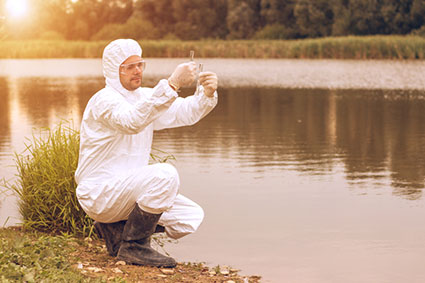
Chemical testing for water quality.
There are two main ways that agencies determine a water source's water quality: chemical testing and bioassessment.
To determine water quality, scientists can collect samples of water to measure and analyze characteristics such as temperature, dissolved mineral content, and number of bacteria in the water. Scientists will measure chemical properties directly such as pH, alkalinity, oxygen content, amount of mercury, and the concentration other substances dissolved in water such as phosphates. This type of testing is chemical testing. Through chemical testing, scientists can get precise measurements of pollutants that affect the water's quality.
Bioassessment
Bioassessment is another method that is used by scientists to determine the overall quality of a source's water. With bioassessment, scientists study the types and numbers of living organisms present in the water. This method does not give you exact measurements of the different areas of the water's chemistry. Bioassessment does allow you to see a water source's overall water quality. Certain organisms are very sensitive to pollutants and the presence and number of these organisms in the water gives scientists a good idea of water quality. The poorer the quality of water the fewer of types and numbers of organisms that can live in it.
The major types of organisms that are used to determine water quality are benthic macroinvertebrates. Macroinvertebrates are organisms that are large enough to be seen with the naked eye don't require a microscope to see and don't have a backbone. Arthropods are one example of macroinvertebrates. Benthic refers to the bottom of bodies of water. These are organisms such as insect, insect larvae, crayfish, worms, and leeches that live mostly on the bottom of the river, stream, lake, or pond and are primarily stationary do not move around .
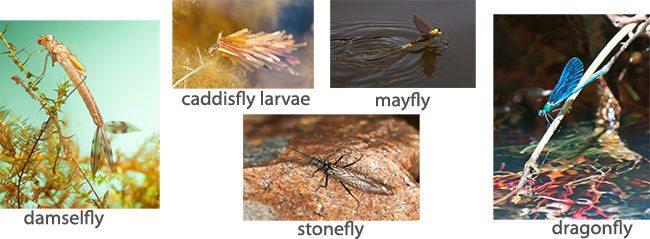
Examples of macroinvertebrates used in bioassessment are the larvae of mayflies, stoneflies, caddisflies, damselflies, and dragonflies. These organisms have a larvae stage that lives in the water (usually on the bottom) until they become adults. These organisms are very sensitive to water quality, so the more of these type of organisms you find, the better the quality of the water.
Organisms such as snails, scuds, leeches, and midges tend to have a higher tolerance to pollutants and are not as good of an indicator as to the water's overall quality. Scientists will use nets and other equipment to collect samples of these organisms and determine population sizes of these organisms to help determine the overall water quality of an area.
 |
 |