Learn
Browning
In this unit, you have been studying about the French Revolution and you learned about a famous and infamous historical figure in history — Napoleon Bonaparte. In fact, over 200,000 books have been written about him and what he did during his military and political career.
The poem below describes a battle that actually took place in 1809 during the Napoleonic Wars. Ratisbon, also known as Regensberg, a Germanic city located on the Danube River is the site of the battle you will be reading about in this lesson. The following poem was written by Robert Browning, an English Romantic poet who wrote many poems about real-life events. Read the poem and see if you are able to determine anything about Napoleon the leader and the man.
Incident of the French Camp
By Robert Browning
You know, we French stormed Ratisbon:
A mile or so away,
On a little mound, Napoleon
Stood on our storming-day;
With neck out-thrust, you fancy how,
Legs wide, arms locked behind,
As if to balance the prone brow
Oppressive with its mind. SummaryThis is a description of what Napoleon looked like on the day of the Battle of Ratisbon and how he stood on a mound away from the battle watching it unfold.
Just as perhaps he mused, "My plans
That soar, to earth may fall,
Let once my army-leader Lannes
Waver at yonder wall."SummaryHe worried that he might lose the battle if Marshal Lannes couldn't breach the city.
Out 'twixt the battery-smokes there flew
A rider, bound on bound
Full-galloping; nor bridle drew
Until he reached the mound.SummaryAs he was thinking about this, a rider on a horse came toward him at a full gallop
Then off there flung in smiling joy,
And held himself erect
By just his horse's mane, a boy:
You hardly could suspect
(So tight he kept his lips compressed
Scarce any blood came through)
You looked twice ere you saw his breast
Was all but shot in two.SummaryA boy who was so happy to be able to tell Napoleon jumps off his horse in front of Napoleon to tell him that the battle against Austria is a victory. The boy had been shot in the chest and he kept his lips closed so that no one would see the blood.
"Well," cried he, "Emperor, by God's grace
"We've got you Ratisbon!
"The Marshal's in the market-place,
And you'll be there anon
To see your flag-bird flap his vans
Where I, to heart's desire,
Perched him —" The chief's eye flashed; his plans
Soared up again like fire. SummaryHe proudly tells him the news and tells Napoleon that he placed the French flag of victory in Ratisbon and Napoleon is delighted with the news.
The chief's eye flashed, but presently
Softened itself, as sheathes
A film the mother-eagle's-eye
When her bruised eaglet breathes,
"You're wounded!" "Nay," the soldier's pride
Touched to the quick, he said:
"I'm killed, Sire!" And his chief beside,
Smiling the boy fell dead.SummaryThough he is excited by the victory, Napoleon sees his young soldier is wounded. The loyal and patriotic young man is so proud to be noticed by Napoleon and to have been able to bring the news at the victory that he dies at Napoleon's feet with a smile on his face.
Thévenin
The Storming of the Citadel of Ratisbon
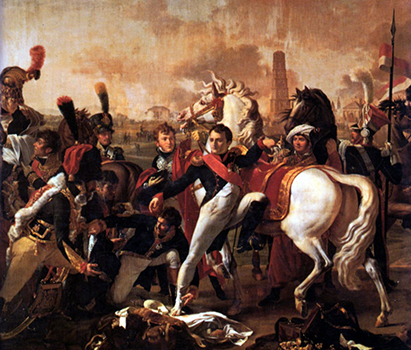
In order to help you get a better sense of what the battle might have been like, look at the following two images of the Battle of Ratisbon. Both paintings were created by artists who lived during the period of the French Revolution and Napoleon’s rule. The first is The Storming of the Citadel of Ratisbon by Charles Thévenin.
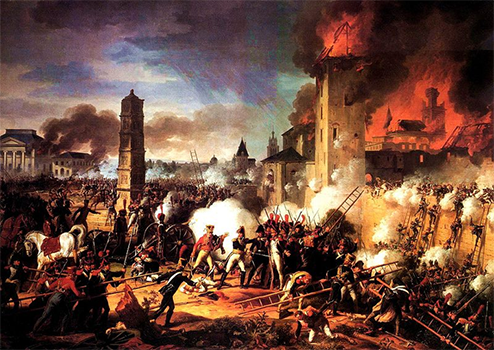
In this painting, you will notice that there is a figure
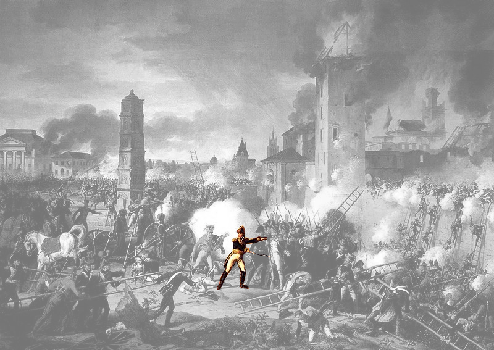 in the center of the painting. He is Marshal Lannes who served Napoleon by leading the infantry in an assault on the city, and he is mentioned in the poem
In the third stanza: "The Marshal’s in the market-place"
.
in the center of the painting. He is Marshal Lannes who served Napoleon by leading the infantry in an assault on the city, and he is mentioned in the poem
In the third stanza: "The Marshal’s in the market-place"
.
The battle, a victory for Napoleon, was a fierce one with many losses and casualties on both sides. Austrian troops suffered the loss of over six thousand men. France lost approximately one third of that number.
Napoleon Wounded at Ratisbon
The second painting by Pierre Gautherot, Napoleon Wounded at Ratisbon, depicts a wounded Napoleon
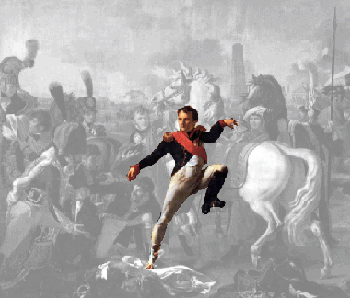 (not a serious wound) at the Battle for Ratisbon. He was hit by a long-range stray bullet in the ankle
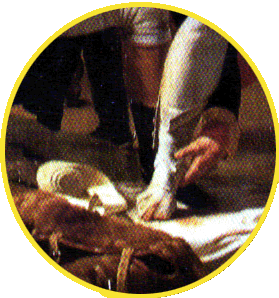 .
.
As with the poetry and music, you can see that artists also painted images of events that depicted the happenings during their lifetimes.