Learn
Formulas for Solving Triangles
In this lesson, you will use the following formulas for solving triangles. Click on each tab to review each formula.
Law of Sines
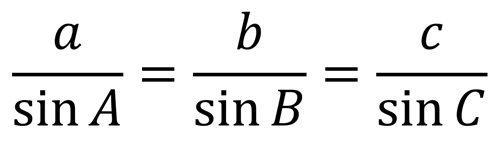
Use the Law of Sines if you know:
- Two angles and one side (AAS or ASA)
- Two sides and a non-included angle (SSA)
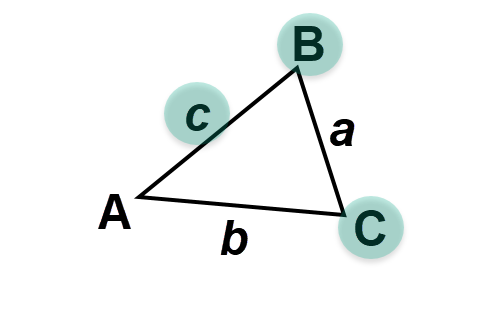
Law of Cosines
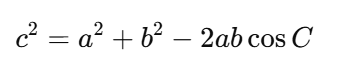
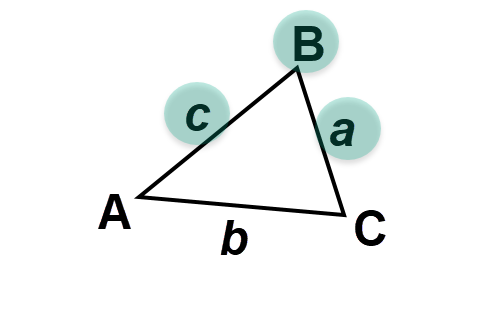
Use the Law of Cosines if you know:
- Two sides and the included angle (SAS)
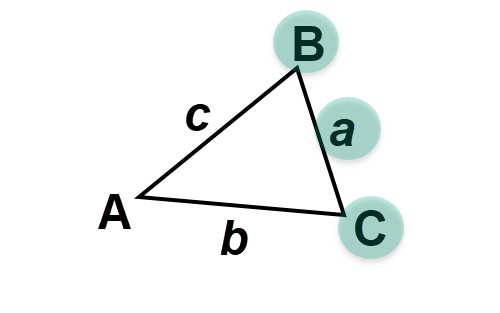
Heron's Formula
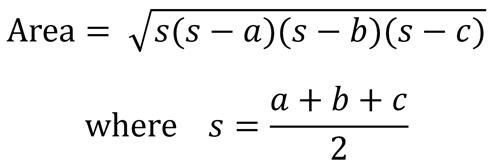
Use Heron's formula if you know:
- Three sides (SSS)
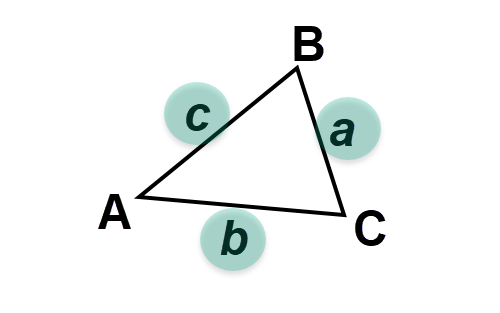
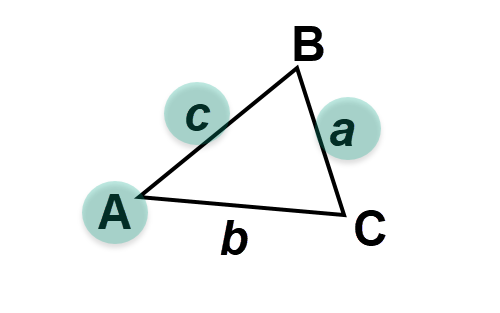
Area of an Oblique Triangle
Deriving the Area of an Oblique Triangle
The procedure used to prove the Law of Sines leads to a simple formula for the area of an oblique triangle. Note that by using right triangle trigonometry, the height can be rewritten by
sin A = 
h = c sin A
Area =  base × height
Area = b × c sin A
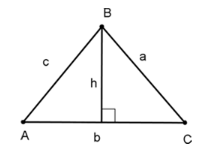
By similar arguments, you can develop the following formulas:
Area = ab sin C
Area = ac sin B
The area of any triangle is given by one-half the product of the lengths of two sides times the sine of their included angle. That is:
Area = bc sin A
Area = ac sin B
Area = ab sin C
Determine the Area of an Oblique Triangle Using the Length of Two Sides and the Sine of the Included Angle
Another Example
Watch the Brightstorm video Using Sine to Calculate the Area of a Triangle for another example.
Deriving Heron’s Formula
The Law of Cosines can be used to establish an alternate formula for the area of a triangle, one that can be used if you know the measures of sides only. The formula is credited to the Greek mathematician Heron (c. 100 B.C.E.)
(Don’t get too caught up in the derivation of Heron’s formula. We are showing you how it was developed, but the critical part is that you know how to apply it.)
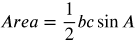
In order to derive this formula, we will square the right side, then find the square root of the square.
Area = 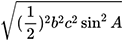
Square the terms and use a Pythagorean Identity to substitute for sin2 A.
Pythagorean Identity:
- sin2x + cos2x = 1
- tan2x + 1 = sec2x
- cot2x + 1 = csc2x
Area = 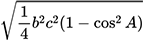
We can now see that we have a difference of squares. Use this to simplify.
Area = 
Under the law of cosines, we can find a way to simplify the terms under the radical.
Law of cosines:
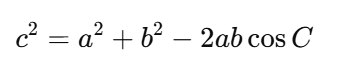
bc (1 + cos A) =  ×

bc (1 − cos A) =  ×

Where did these expressions come from?
Remember, we started with the formula Area = bc sin A.
We now have Area =
We also know we can use the law of cosines to simplify the terms under the radical.
If you let s = (a + b + c) − in other words, s is one-half the perimeter of the triangle – then you can write:
bc (1 − cos A) = × = (s − b)(s − c)
bc (1 + cos A) = × = s(s − a)
to replace the expressions under the radical.
Then substitute these expressions back in. You get:
Area = 
Heron's Formula
If the only information you are given for a triangle are the three side lengths, then you find the area by first finding s, which is one-half the perimeter of the triangle. Then, you take the square root of the product of s and the difference between s and each side length.
s = (a + b + c)
Area =
To practice using Heron's formula, go to Geogebra: Heron's Area Formula. Change the sides of the triangle by dragging the vertices. Use the Hint and Check Answer functions to check your work.
Determine the Area of an Oblique Triangle Using Heron's Formula
Open Determine the Area of an Oblique Triangle Using Heron's Formula in a new tab