Learn

Power-Reducing Formulas

Let’s look at the cos 2x formulas and use them to derive the power-reducing formulas:

cos 2x = 1 − 2 sin2x

Subtract 1 from both sides

cos 2x = 1 − 2 sin2x

Divide by −2

the fraction with numerator cosine 2 x minus 1 and denominator negative 2 equals sine squared x

Rearrange

sine squared x equals the fraction with numerator 1 minus cosine 2 x and denominator 2

Power-Reducing Formulas

Let’s look at the cos 2x formulas and use them to derive the power-reducing formulas:

cos 2x = 2 cos2x − 1

Add 1 to both sides

cos 2x + 1 = 2 cos2x

Divide by 2

the fraction with numerator cosine 2 x plus 1 and denominator 2 equals cosine squared x

Rearrange

cosine squared x equals the fraction with numerator cosine 2 x plus 1 and denominator 2

Power-Reducing Formulas

In order to find the tan2x let’s use the quotient identity tangent x equals sine x over cosine x

tangent squared x equals sine squared x over cosine squared x

Substitute the formulas we just found

tangent squared x equals the fraction with numerator the fraction with numerator 1 minus cosine 2 x and denominator 2 and denominator the fraction with numerator cosine 2 x plus 1 and denominator 2

Simplify

tangent squared x equals the fraction with numerator 1 minus cosine 2 x and denominator cosine 2 x plus 1

The Power-Reducing Formulas

  • sine squared x equals the fraction with numerator 1 minus cosine 2 x and denominator 2
  • cosine squared x equals the fraction with numerator 1 plus cosine 2 x and denominator 2
  • tangent squared x equals the fraction with numerator 1 minus cosine 2 x and denominator 1 plus cosine 2 x

Half-Angle Formulas

The half-angle formulas are derived from the power-reducing formulas.

sine squared x equals the fraction with numerator 1 minus cosine 2 x and denominator 2

Replace x with x over 2

the sine squared of x over 2 equals the fraction with numerator 1 minus cosine x and denominator 2

Take the square root of both sides

the sine of x over 2 equals plus or minus the square root of the fraction with numerator 1 minus cosine x and denominator 2

Notice that 2x becomes x when x is replaced with x over 2

Half-Angle Formulas

The half-angle formulas are derived from the power-reducing formulas.

cosine squared x equals the fraction with numerator 1 plus cosine 2 x and denominator 2

Replace x with x over 2

the cosine squared of x over 2 equals the fraction with numerator 1 plus cosine x and denominator 2

Take the square root of both sides

the cosine squared of x over 2 equals the fraction with numerator 1 plus cosine x and denominator 2

Notice that 2x becomes x when x is replaced with x over 2

Half-Angle Formulas

The half-angle formulas are derived from the power-reducing formulas.

tangent squared x equals the fraction with numerator 1 minus cosine 2 x and denominator 1 plus cosine 2 x

Replace x with x over 2

the tangent squared of x over 2 equals the fraction with numerator 1 minus cosine x and denominator 1 plus cosine x

Take the square root of both sides

the tangent of x over 2 equals plus or minus the square root of the fraction with numerator 1 minus cosine x and denominator 1 plus cosine x

We now need to simplify the radical.

Simplifying the Tangent Half-Angle Formula

the tangent of x over 2 equals plus or minus the square root of the fraction with numerator 1 minus cosine x and denominator 1 plus cosine x

To simplify, multiply either by the conjugate of the denominator, or by the conjugate of the numerator.

 Conjugate of the denominator    Conjugate of the numerator
 the tangent of x over 2 equals plus or minus the square root of the fraction with numerator 1 minus cosine x and denominator 1 plus cosine x times open paren the fraction with numerator 1 minus cosine x and denominator 1 minus cosine x close paren    the tangent of x over 2 equals plus or minus the square root of the fraction with numerator 1 minus cosine x and denominator 1 plus cosine x times open paren the fraction with numerator 1 plus cosine x and denominator 1 plus cosine x close paren
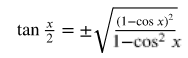
 3 lines Line 1: the tangent of x over 2 equals plus or minus the square root of the fraction with numerator open paren 1 minus cosine x close paren squared and denominator open paren 1 minus cosine x close paren squared Line 2: the tangent of x over 2 equals plus or minus the square root of the fraction with numerator open paren 1 minus cosine x close paren squared and denominator sine squared x Line 3: the tangent of x over 2 equals plus or minus the fraction with numerator 1 minus cosine x and denominator sine x  Pythagorean identity sin2x + cos2x = 1
Find the square root
 3 lines Line 1: the tangent of x over 2 equals plus or minus the square root of the fraction with numerator 1 minus cosine squared x and denominator open paren 1 plus cosine x close paren squared Line 2: the tangent of x over 2 equals plus or minus the square root of the fraction with numerator sine squared x and denominator open paren 1 plus cosine x close paren squared Line 3: the tangent of x over 2 equals plus or minus the fraction with numerator sine x and denominator 1 plus cosine x

The Half-Angle Formulas

  • the sine of x over 2 equals the square root of the fraction with numerator 1 minus cosine x and denominator 2
  • the cosine of x over 2 equals the square root of the fraction with numerator 1 plus cosine x and denominator 2
  • the tangent of x over 2 equals plus or minus the fraction with numerator 1 minus cosine x and denominator sine x or plus or minus the fraction with numerator sine x and denominator 1 plus cosine x
  • The sign ± depends on the quadrant x over 2 is in.

Use Half-Angle Formulas to Find Exact Trigonometric Values

Open Use Half-Angle Formulas to Find Exact Trigonometric Values in a new tab

Use Power-Reducing Formulas to Rewrite Trigonometric Expressions

Open Use Power-Reducing Formulas to Rewrite Trigonometric Expressions in a new tab

Use Half-Angle Formulas to Solve Trigonometric Equations

Open Use Half-Angle Formulas to Solve Trigonometric Equations in a new tab