

Static charge is formed when charges build up on an object. We charged the pieces of tape in lesson 1 by pulling the tape from a surface and pulling charges from the surface onto the tape. The addition of charges on the tape caused it to have more charge than other objects and the tape then induced a charge difference in objects as it was brought close to them.
Static charge can also be formed by rubbing two objects together. When the objects are then brought close to another object, a discharge may occur as the charges move from areas of high concentration to low concentration.
Learn more about static electricity in balloons at PhET: Balloons and Static Electricity. Use your mouse to move the balloon across the sweater and pick up negative charges. Then move the balloon towards the wall and see how the charges move. Why does the balloon stick to the wall?
Answer: the charged balloon induces a charge on the wall by attracting the positive charges.
From the simulation, we see that there are two types of electric charge. One is positive and one is negative. We will learn more about these charges when we study the atom, but now you should now that the negative charged particles are electrons and the positive charged particles are protons. These charged particles are represented by a plus sign, + and a minus sign, - .
When objects are rubbed together, mechanical energy is used to move the charges and create static electricity. Mechanical energy can also be used to create moving charges which can be used to power our lights and other electrical equipment.
The electric generator you learned about in 4.01 used the power of water flowing through a dam to move a huge turbine which contained magnets. The moving magets induced a flow of charge in the wires connected to the power lines. All electrical generating power plants work the same way, but they differ in how the power is supplied to turn the turbine which generates the electric current. This picture shows a plant which burns coal to boil water to make steam which is used to turn the turbine.
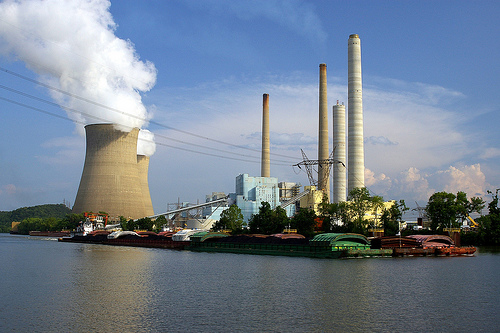
Image courtesy of flickr user Wigwam Jones. This image is protected by a Creative Commons Attribution-Noncommercial-Share Alike 2.0 Generic license.
The huge tower on the left is a cooling tower which helps cool the water that was used to make the steam. The water is cooled to normal temperatures before being returned to the river in the foreground. This helps prevent heat pollution of the environment. The tall chimneys are connected to the furnaces where the coal is burned to heat the water into steam which drives the turbines.
Natural gas is also used in some power plants.
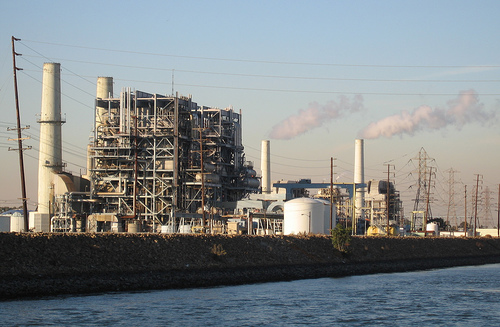
Image courtesy of flickr user Mollivan Jon. This image is protected by a Creative Commons Attribution-Share Alike 2.0 Generic license.
Natural gas burns much cleaner than coal but the water still must be cooled before returning it to the environment.
Nuclear power is also used to boil water to make steam to drive the turbine generators. Watch this video to learn more about nuclear energy.