
- Introduction
 Lesson
- Try it!
- Review & Tasks

Kinetic energy is the energy of motion. Kinetic energy is related to speed. The formula for kinetic energy is:
KE = ½mv2
For example, a 1,000 kg car moving 10 m/s would have a kinetic energy of ½ x 1000 x 10 x 10 = 50,000 J.
Notice that kinetic energy, potential energy and work all have the same units, Joules. Knowing this, we can determine how much energy our roller coaster car will have at the bottom of the hill because we know how much potential energy it has at the top of the hill.
Our 500 kg car had a potential energy of 25,000 J or 25 KJ at the top of the hill. At the bottom of the hill, all of the potential energy would be converted to kinetic energy, so at the bottom of the hill, our car would have 25,000 J or 25KJ of energy.
At points along the slope of the hill, as we descend, some of the potential energy would be changed to kinetic energy but some would still be potential energy, because we are still above the ground.
As the coaster descends the hill, speed increases. GPE is converted to KE. As GPE decreases, KE increases.
At the start, GPE is maximum and KE is zero. At the bottom of the hill, GPE is zero and KE is maximum. At a point halfway down the hill, GPE = KE.
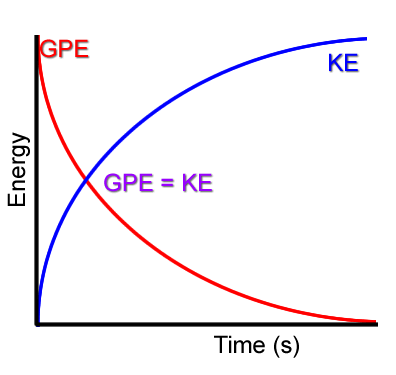
Because of friction, the kinetic energy will never be equal to the gravitational potential energy of the coaster. The friction of the wheels on the track and the bumping and jostling of the ride subtract energy from the final kinetic energy of the car. KE < GPE. But the noise and bumping add to the excitement of the ride, so we don’t notice the slight loss in energy as we descend the hill!