Learn
Newton's Third Law of Motion
Newton's Third Law of Motion states that when one object exerts a force on another object, the other object exerts an equal and opposite force on the first object.
- These forces occur simultaneously.
- They are not cause and effect forces; they are interactions between objects.
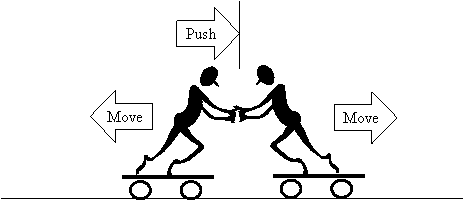
Take a look at the above picture. If the two people put their hands together and one pushes off the other, both will end up moving. As the one skateboarder pushed against the other, the other skateboarder also supplied the same force which was equal but in an opposite direction. These forces causes both skateboarders to move backwards (However, we would have to use Newton's 2nd law to predict their acceleration!)
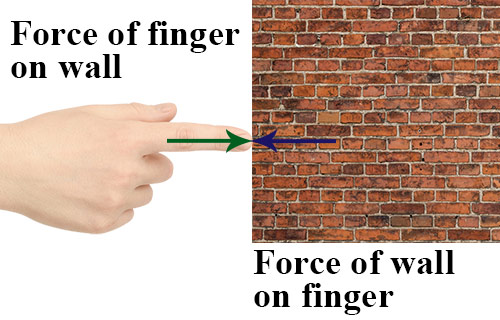
Another way to think about Newton's Third Law is to realize that all forces come in pairs. Push on the wall right now. As you push on the wall, the wall simultaneously pushes back on you. It is a pair of forces which are equal but in opposite directions.
It is important to note that sometimes this law is stated: "For every action, there is an equal and opposite reaction." While this is true, the way the statement is worded seems to imply that the action happens and then is followed by a reaction; or that the action then causes the reaction. Neither of these are true. The forces occur at the exact same time. So, saying "For every action, there is an equal and opposite reaction" is fine as long as you remember that the two forces occur simultaneously at the same time .