Learn
Examples of Newton's Third Law of Motion
Let's look at some real world examples of Newton's Third Law and the idea of forces always coming in pairs. These pairs are often referred to as action-reaction pairs.
Bouncing Ball
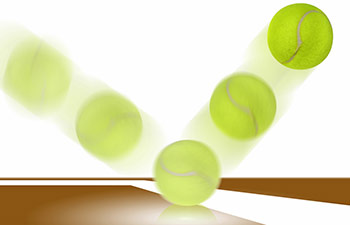
When a bouncy ball is thrown to the ground, why does it bounce back up? Well, the ball hits the ground and exerts a certain amount of downward force on the ground. Since forces come in pairs, at the same time the ball exerts a downward force on the ground, the ground exerts the same amount of upward force on the ball. This causes the ball to bounce back up.
So, why doesn't the ground move since the ball applied a force to it? Hopefully that answer is obvious. Remember from Newton's second law that acceleration depends on both force and mass. The tennis ball did apply a small force to the ground but the mass of the ground (earth) is so large that the force produces no relative acceleration, or movement.
Fish Swimming
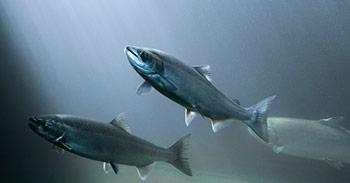
When a fish swims, it uses its fins to push against the water in a backward motion. This is one in a pair of forces. The water then pushes back on the fish with an equal force but in an opposite direction (forwards), which propels the fish through the water. If you have ever been swimming, you have probably done something very similar!
Examples
Lastly, check out the following websites to see how NASA uses Newton's Laws.
- Newton's Laws of Motion (NASA)
- Beginner's Guide to Propulsion (NASA)
- Newton's Triple Play: Baseball.