- Introduction
 Learn
Learn- Try It
- Task
Learn
Fats are one of the three main classes of macronutrients. Another word for fat is lipid. Lipids are found in oils, nuts, seeds, meats, fish, poultry, dairy products, legumes and some vegetables and fruits.
Fat contains 9 calories per gram; to calculate the calories of fat grams use the simple formula: Fat grams × 9 = calories
Learn to choose the right fats and the right amount of fats in your daily dietary routine.

- Role of Fat
- Classification
- Saturated
- Trans Fats
- Unsaturated Fats
- EFAs
- Emulsification
- Antioxidants
- Reading

Fat is used as a form of energy storage. Fat stores can be converted to energy when other, more immediate, reserves are exhausted. An example is that when an athlete has burned all of the immediate energy supply, the body begins converting stored fat to energy. Another example would be in the case of food deprivation.
Another purpose of fat is for insulation against cold external temperatures. The vital organs are protected with padding and insulation from trauma and temperature change. Native Eskimo people are a good example of how fat can insulate from extreme cold temperatures. In fact, fatty tissue is helping each of us regulate body temperature in every moment.

The components of fats known as fatty acids are important in metabolic functions in all systems of the body. A good approach to fat consumption is eating to obtain these healthy essential fatty acids. Fats also carry fat soluble vitamins like vitamin A, D, E and K.
About 95% of fats are in the form of simple fats known as triglycerides. Triglycerides break down into two classes of fats called saturated and unsaturated.
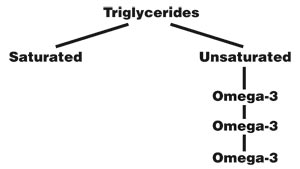
Saturated fats come from meats, dairy products, egg yolks, fish, coconut oil, and palm oil. Saturated fats are very stable and very resistant to rancidity.
While you should be cautious of eating too many of these fats, healthy natural versions are an important component of a well-rounded diet. One example of how important these fats are is their use in the cell membrane structure. An example of a healthy saturated fat is conjugated linoleic acid. This fatty acid has been shown to be very beneficial to health in a variety of ways.
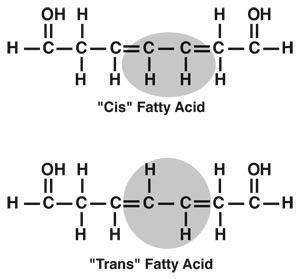
This diagram shows the placement of carbon-hydrogen bonds in "cis" (good) and
"trans" fatty acids. Note how the bonds differ between these molecules.
Which saturated fats are harmful and why?
Natural saturated fats found in nature — such as those in coconut or palm oil--are all right to eat in moderation. In fact, new evidence shows that these sources of fats are beneficial and helpful in a well-rounded diet. The saturated fats show up in two forms: "cis" fatty acids and "trans" fatty acids. The "cis" form is found in nature, and is the healthy form of saturated fat. Because the "cis" form has two hydrogen atoms on one side, other chemicals and enzymes can bind to it, thus allowing the molecule to become useful in digestion and metabolism.
The "trans" form is found minimally in nature, and is primarily the creation of industry through the process of hydrogenation. In "trans" fats, the hydrogen atoms are on opposite sides of the molecule, making it much more difficult for other chemicals and enzymes to bind to it. This is why these unnatural fats remain primarily undigested. Over time, these undigested "trans" fats build up and cause harm.
Additional reading for more information: An excellent explanation of this difference can be found at Trans fat, the real culprit of western ill-health.
Scientific health studies have shown that man-made, unnatural trans-fats are the most harmful fats and should be avoided. Trans-fats are created when oil is heated and combined with hydrogen, a process called hydrogenation or partial hydrogenation. These fats are very useful for the food industry because they extend shelf life and have a good consistency and taste.
However, what is good for the profits of the food companies that use these products has contributed to the creation of a major health problem for our country. Trans fats have now been banned in some places in the United States, and the public is being alerted as to the dangers present in consuming foods containing these substances. A good sign is that many companies are cooperating by finding alternative ways of making their products and proudly displaying that they are "trans-fat free."
Unsaturated Fats
These fats come primarily from plants and seeds. They are less stable than saturated fats, and as a result spoil more quickly. These fats are very healthy, as they contain the components called essential fatty acids.
EFA's can be classified into three categories: omega-3, omega-6, and omega-9.
Omega-3: Also known as super unsaturated, omega-3 is very beneficial for your body. Alpha linolenic acid (ALA) is the primary omega-3 EFA. However, EPA and DHA are also very important omeg-3 EFAs. All of these are involved in many systems of your body and will help in maintaining or improving blood pressure, cholesterol levels, brain and nervous system function, immune system, triglyceride levels and much more.
Where to find omega-3: Flaxseed oil, flaxseeds, flaxseed meal, hempseed oil, hempseeds, walnuts, pumpkin seeds, Brazil nuts, sesame seeds, avocados, some dark leafy green vegetables, canola oil, soybean oil, wheat germ oil, salmon, mackerel, sardines, anchovies, albacore tuna, and others.
Omega-6: Linoleic Acid (LA) is the primary Omega-6 fatty acid. Most people get enough LA in their diets because the dietary habits of Americans create a higher omega-6 intake than omega-3 or -9. For this reason it is not as crucial to concentrate on this category of EFAs unless there is a therapeutically related reason.
Omega-9: Also known as Oleic acid, omega-9 is a monounsaturated fat that has been shown to lower heart attack risk and arteriosclerosis, and aid in cancer prevention. Olive oil (extra virgin or virgin), olives, avocados, almonds, peanuts, sesame oil, pecans, pistachio nuts, cashews, hazelnuts, and macadamia nuts, contain this vital EFA.
Fats and oils are emulsified in the small intestine by the action of bile salts through a process that forms a liquid known as an emulsion. An emulsion contains very small droplets of fat or oil suspended water or other fluid. Emulsification increases the surface area of these lipids, making them easier to digest. Non-emulsified fat usually passes through the intestines and is eliminated in feces.
Another important fat emulsifier group is the phospholipids. The most common phospholipid is lecithin. Because of their carbohydrate-fat structure, phospholipids move well in fats and in water. This allows them to move easily in and out of cells. Lecithin is used, for instance, in cod liver oil supplement production as an emulsifier which allows for easier digestion of the cod liver oil. Lecithin is consumed as a dietary supplement, as it assists the breakdown of fats by the liver and gall bladder.
You probably have heard of the term antioxidant. The idea of oxidation and antioxidants are very basic to chemistry and metabolism. It is important to understand some basic terms and their meanings when it comes to the idea of antioxidants. Let's introduce two terms that describe two basic types of chemical reactions that happen.
- Anabolic reactions means building up, when two atoms or molecules combine to form another compound. A good example of this is photosynthesis.
- Catabolic reactions means to break down, when a molecule is broken down into smaller components usually as a result of enzymatic action. A good example of this is glycolysis. When we spoke of the enzymatic reactions in the earlier lesson on digestion, we could have called them catabolic reactions.
Let's now look more closely at the catabolic reaction.
One of the most basic reactions is that of oxygen with other substances. When oxygen interacts with another substance, a catabolic reaction called oxidation occurs. Oxidation is a reaction in which the atoms in an element lose electrons due to an interaction with oxygen. The molecule being oxidized donates an electron and so is oxidized. A by-product of this reaction is a free electron called a free radical. Oxidation is a natural process that is a part of the chemistry of the outer world as well as inside our bodies; the free radicals can be a source of further problems if they become too numerous.
Two recognizable examples of oxidation are an apple cut in half, beginning to turn brown, or the rust that forms on your bicycle fender. One could think of oxidation in your body as metabolic rust.
Free radicals are highly unstable and can have a positive or negative charge. This means free radicals scavenge the body looking for a place to donate an electron or a place to take one, depending on the charge they carry. This process is highly destructive to other substances and tissues in the body.
An antioxidant, then, is a molecule that can donate or receive and electron to the highly unstable free radical, making it stable and harmless again.
Antioxidants can be used to preserve products (such as unsaturated oils) that are particularly susceptible to oxidation. To do this, an antioxidant substance can be added to products to slow down the oxidation rate.
Antioxidants can also be used to help preserve your tissues by reducing the amount of free radicals within your body. Oxidation and free radicals are some of the most fundamental underlying causes of premature aging and disease. Eating antioxidant-rich foods, such as blueberries or oranges, will help reduce the oxidation rate within your cells.
In addition, other outside influences can be oxidative. Sunlight, for instance, has a strong oxidative effect on substances it comes into direct contact with. For this reason, it is important to keep oils and other perishable items out of direct sunlight.
For a much more in-depth study on oxidation and health, go to Molecular Biology of Oxygen, Basics. Scroll down to the heading Seven Scientific Terms.
Explore your daily fat intake.
As you go through the reading, answer the following questions in your notebook.
- How much fat should I eat in one day?
- What types of fats are healthiest?
- What is a healthy cholesterol level?
Read and study the pages at the following links:
- Nutrition basics
- The Nutrition Source by Harvard School of Public Health
As you read, look for the following key topics:
- Fat consumption levels
- Saturated, unsaturated, triglycerides and trans fats
- Cholesterol