- Introduction
 Learn
Learn- Try It
- Task
Learn

Carbohydrates are produced by photosynthesis in plants. They are the primary source of energy in nature's plant foods — fruits, vegetables, grains, legumes, and tubers. Endurance athletes know that they are the best source of energy because they provide both immediate and time-released energy sources. Carbohydrates can be considered our main source of energy. Carbohydrates are composed of carbon [C], hydrogen [H], and oxygen [O], thus the abbreviation CHO. The basic chemical relationship is that of carbon coupled with water molecules. Because this chemical coupling can easily be converted to glucose to fuel the cells, carbohydrates are a quick source of energy.
Examples of high carbohydrate foods:
There is still controversy and confusion over the classification of CHOs. As our understanding of CHOs has evolved, there have been changes in the language describing the CHOs. Here is the latest World Health Organization chart that classifies CHOs:
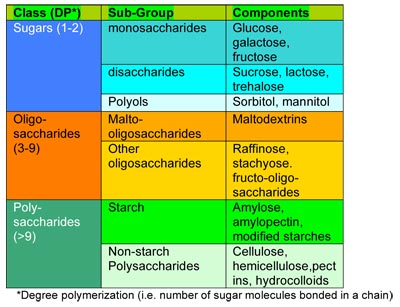
Simple Carbohydrates — These are monosaccharides and disaccharides. Simple carbohydrates are quicker to digest, which causes a fast rise in blood sugar. Examples of monosaccharides are fructose, galactose, and glucose. Examples of disaccharides are lactose, sucrose, and maltose.
Oligosaccharides — Medium Chain Sugars — These are three- to nine-molecule chain sugars that are usually created as a result of the break down of polysaccharides. Examples of oligosaccharides are maltodextrin and fructo-oligosaccharides.
Complex Carbohydrates — These are known as starches or polysaccharides Complex carbohydrates require more amylase to digest, and therefore cause a slower and more sustained rise in blood sugar. Examples of complex CHOs are amylose, starches, and pectins.
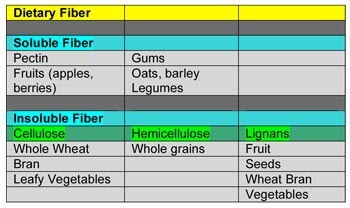
Fiber is an important part of carbohydrates. Fiber slows down the absorption of CHOs and provides many other important functions both in the digestive tract and the cardiovascular system.
When you eat carbohydrates, your body is provided with four calories per gram eaten. This allows you to easily calculate the calories when looking at the grams of carbohydrates on a food label. Simply follow the formula: CHO grams × 4 = calories
So, the number of calories in 20 g of carbohydrate can be found as below.
20 g CHO = 20 g × 4 calories/g = 80 total calories.
Refined vs. Unrefined Carbohydrates
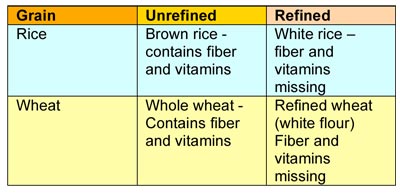
It is important to note that since the late 19th century, many carbohydrate foods have been altered. Today, we speak of refined or unrefined foods. Refined foods have been mechanically stripped down into smaller parts. These smaller parts are then used to create common foods in a way that is more appealing, but often less healthy and disease-promoting in some way.
Unrefined foods are in their original state and contain all of their original components. Carbohydrates are one of the primary food groups that have been substantially changed. Because of this alteration, the effect of refined carbohydrates on our bodies is very different than the effect of the unrefined whole form. Without the fiber, refined carbohydrates digest more like simple carbohydrates, causing a much faster rise in blood sugar than more complex unrefined form.
Modern Day Carbohydrates
The unrefined whole carbohydrates provide starches, fiber, protein, vitamins and minerals. Starches are broken down into glucose or glycogen and used or stored. Fiber binds to toxins and is important in moving undigested matter through the intestinal tract. Another very significant effect fiber has is to slow down the digestion and absorption of sugars. Unrefined CHOs are also abundant in vitamins and minerals which are important micronutrients needed for many functions in the body.
Refined CHOs are stripped down and have very little, if any, fiber, vitamins or minerals. What is left is starch and protein. White wheat flour and white rice are the most abundantly used examples of this food type.
A Lesson From the History Books
In the early 20th century, machine processing of food led to the invention of white flour, used to make white bread. After a decade or so of this mass consumption of this food, a vitamin deficiency disease known as rickets became an epidemic across the nation. A congressional inquiry was conducted and it was revealed that this new processed food was the source of the problem. Laws were passed and it was mandated that specific B vitamins must be added back into the bread to be legally sold to the public. This is what we know today as enriched white bread.
Read the The Carbohydrate Connection. As you read, look for the following key topics:
- How carbohydrates are used in the body
- The difference between simple and complex carbohydrates
- How many calories carbohydrates contain
- Which carbohydrates are healthiest
- How fiber affects carbohydrate digestion
Watch Nutrients (03:01). Login information