Learn
Exploring Solids
Vocabulary
Polyhedron: a solid that is bounded by polygons that enclose a single region of space. The plural is polyhedra.
Faces: the polygons that form a polyhedron
Edge: a line segment formed by the intersection of two faces
Vertex: a point where three or more edges meet. The plural is vertices.
Types of Solids
Polyhedra:
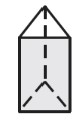
Prism - A polyhedron formed by two parallel congruent polygonal bases connected by lateral faces that are parallelograms.
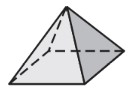
Pyramid - A polyhedron formed by a polygonal base and triangular lateral faces that meet at a common vertex.
Not Polyhedra:
Cylinder - A three-dimensional figure with two parallel congruent circular bases and a curved lateral surface that connects the bases.

Cone - A three-dimensional figure with a circular base and a curved lateral surface that connects the base to a point called the vertex.

Sphere - The set of points in space that are a fixed distance from a given point called the center of the sphere.

Regular Polyhedrone
There are exactly five types of regular polyhedra. A polyhedron is regular if all of its faces are congruent regular polygons and the same number of faces meet at each vertex. The regular polyhedra are called Platonic solids. The five regular polyhedra are named Platonic solids after the Greek mathematician and philosopher Plato.
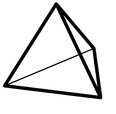
4 faces - Tetrahedron
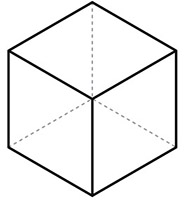
6 faces - Hexahedron
8 faces - Octahedron
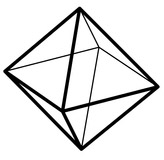
12 faces - Dodecahedron
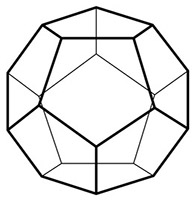
20 faces - Icosahedron
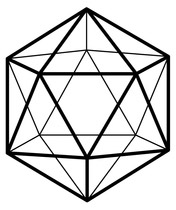
Convex and Concave Polyhedra
A polyhedron is convex if any two points on its surface can be connected by a segment that lies entirely inside or on the polyhedron. If this segment goes outside the polyhedron, then the polyhedron is nonconvex, or concave.
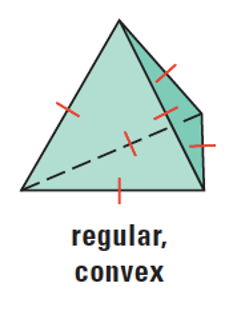
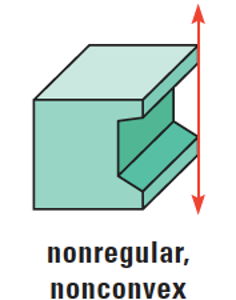
Example #1
Open Determine if a Solid is a Polyhedron in a new tab
Cross Sections
A cross section is the intersection of a plane and a three-dimensional figure.
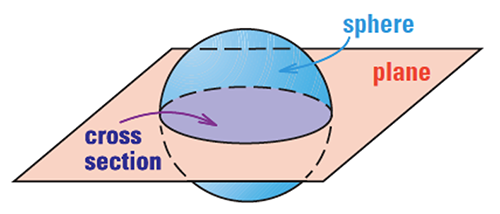
Example #2
Open Describe a Cross-Section in a new tab
Euler's Theorem
Euler’s Theorem: The number of faces, vertices and edges of a polyhedron are related by the formula F + V = E + 2, where F = faces, V = vertices, and E = edges
Now go back to your table that you created in the Explore Activity. Do you see the relationship between the number of faces, vertices, and edges that is stated in Euler’s Formula?
Example #3
Find the number of vertices a polyhedron has if it has 11 faces (5 quadrilaterals and 6 pentagons)
OK, so we know the number of faces. In order to use Euler’s Theorem, we must first establish the number of edges. 5 quadrilaterals have 5 x 4 edges (20 total). 6 pentagons have 6 x 5 edges (30 total). Based on this information, 50 edges have been identified. The thing to remember, though, is that each side is shared by two faces, so there are 25 edges for the polyhedron.
F + V = E + 2
Euler's Theorem
11 + V = 25 + 2
Since we now know the number of faces and edges, substitute 11 and 25 into Euler's Theorem.
11 + V = 27
Simplify the right side of the equation by adding 25 and 2
V = 16
Isolate V by subtracting 11 from each side. 27 - 11 = 16