Adjacent and Congruent Angles
Remember to take good notes to study.
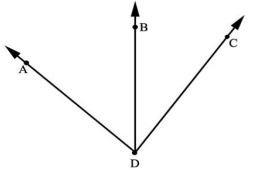
∠ADB + ∠BDC = ∠ADC
Vocabulary
- adjacent angles
- measure
- congruent angles
- angle bisector
- angle addition postulate
Adjacent Angles
Adjacent angles are two angles that share the same vertex and side. You cannot name angles such as these with just one letter because there is more than one angle at the vertex. In this case you would have to use three letters to name each angle. Remember, the vertex is always the middle letter.
One of these angles is ∠ ADB. What is the name of the other angle? ___
∠BDC
or
∠CDB
Answer: ∠BDC
Angle Addition Postulate
If a third ray divides an angle into two adjacent angles then we can say that the sum of the measures of the two adjacent angles is equal to the measure of the whole angle. This is known as the Angle Addition Postulate.
∠ADB
∠BDC
∠ADC
Angle Addition Example
Let’s look at an example using this postulate:
To find the measure of ∠AOC, we would add the two smaller angles together. Hence,
∠AOC = ∠AOB + ∠BOC
∠AOC = 40° + 80°
∠AOC = 120°

Quick Quiz
Now you try.
Find the measure of ∠XYZ.
∠XYZ =∠XYA + ∠AYZ
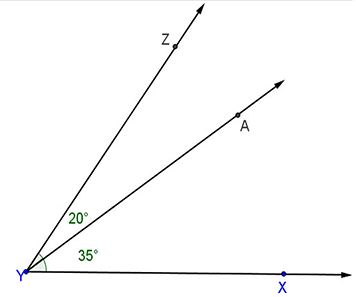
∠XYZ = __ + __
∠XYZ = __
Answer:
∠XYZ = 35° + 20°
∠XYZ = 55°
Find the measure of ∠XYZ.
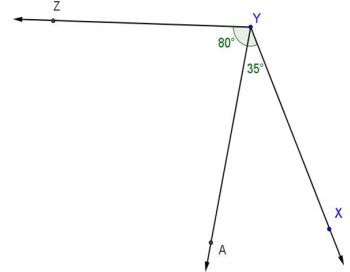
∠XYZ =∠XYA + ∠AYZ
∠XYZ = __ + __
∠XYZ = __
Answer:
∠XYZ =35° + 80°
∠XYZ = 115°
The Measure
Remember that it is very important to learn terminology and symbols to be successful in this course. Here are a few more new concepts.
When you see this written, m∠AOC, it is read as “the measure of angle AOC.” In other words “measure” is abbreviated with the small caps letter m.
Congruent Angles
Also, when two angles have the same exact measure they are called congruent angles.
The symbol for congruent is  .
.

We would write this as: ∠ABC ∠DEF
Congruent is basically a fancy word for equal. This symbol will be used often to identify that two or more figures are equal in size.
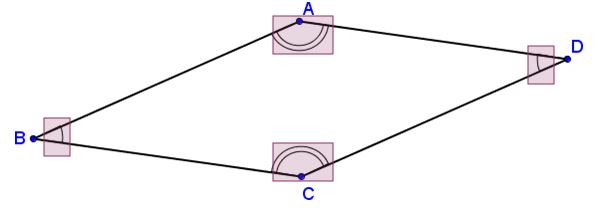
When drawing congruent angles, you use an arc in the middle of the angle to show that two angles are congruent. If two different pairs of angles are congruent, use one set of arcs for one pair, then two sets of arcs for the next pair and so on.
Angle Bisector
An angle bisector is a ray that divides an angle into two adjacent angles that are congruent.
In the diagram, BD
bisects ∠ABC because
it divides the angle
into two congruent
angles, ∠ABD and ∠ CBD. To identify congruent angles matching congruence arcs are placed inside the angles to show they are equal.
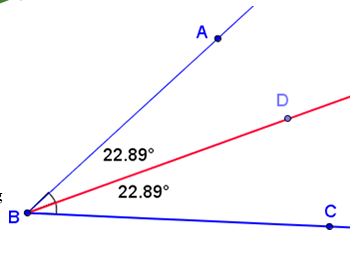
∠ABD
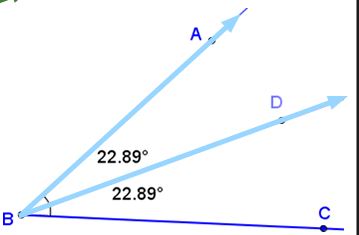
∠CBD
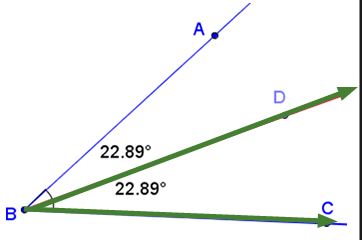
Angle Bisector Solution
An angle bisector divides an angle into two congruent angles, each of which has half the measure of the original angle. So,
m∠RSG = m∠GST = 1/2 (∠RST)=1/2 (140°)=70°
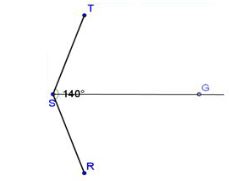
∠RSG
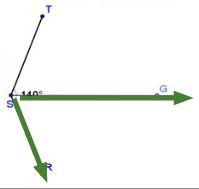
∠GST
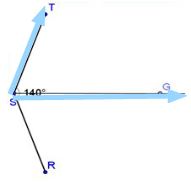
∠RST
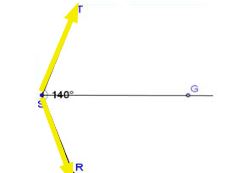
Your Turn
DF bisects ∠CDE. Given that m∠CDE = 70°,
what are the measures of m∠CDF and m∠FDE?
Find the measure of
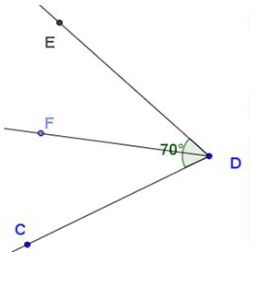
m∠CDF = m∠__ = __ / 2
Answer:
m∠CDF = m∠FDE = CDE / 2
DF
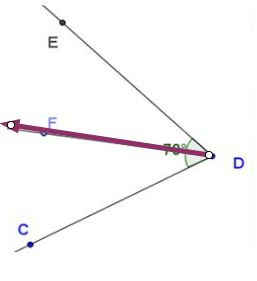
∠CDE
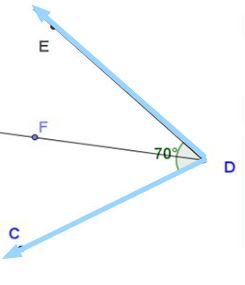
∠CDF

∠FDE

m∠CDF = m∠FDE = m∠EDC ° / 2
m∠CDF = m∠FDE = __ / 2
Answer: m∠CDF = m∠FDE = 70 / 2
m∠CDF = m∠FDE = __
Answer: 35