- Introduction
 Learn
Learn- Try It
- Task
Learn
|
Read and study the following vocabulary words. Click on each link to hear the pronunciation and try saying the words aloud. If you find it difficult to pronounce a certain word, be sure to write down a pronunciation note. Example: la gymnastique (zheem-nah-steek).
Read and study the following vocabulary words. Click on each link to hear the pronunciation and try saying the words aloud. If you find it difficult to pronounce a certain word, be sure to write down a pronunciation note. Example: la pêche (pesh).
Read and study the following vocabulary words. Click on each link to hear the pronunciation and try saying the words aloud. If you find it difficult to pronounce a certain word, be sure to write down a pronunciation note. Example: la batterie (bah-tree).
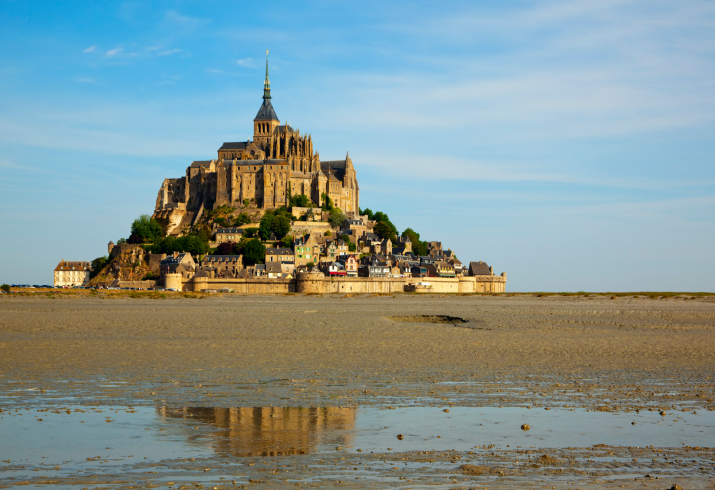
A Gigantic Island Rock, Very High Tides, and Quicksand! In the region of Lower Normandy in northern France, you will find one of the most fascinating geographical features on the face of the earth. It is a cone-shaped granite rock that rises out of the water about one mile from the shore, and its highest point reaches 300 feet. Around this gigantic island rock flow Europe's highest tides. In fact, the tide can change as much as 46 feet (14 meters) in one 24 hour period. The tides rise and fall at such a rapid rate that the change is clearly visible to the human eye. Many French people say that the tide changes "as fast as a galloping horse." In order to understand how significant this tidal change is, the tides in Mobile Bay and Gulf Shores, Alabama change, on average, only 1.5 feet per day.
Let's talk about the quicksand! At high tide, the rock or mount is completely surrounded by several feet of water. At low tide, however, it seems like you could walk all the way to the rock, as you can see all of the sand that surrounds it, but as the French would say, "ATTENTION! - Watch out!" If you try to walk to the rock, you could lose your life! Yes, much of the sand that surrounds the island is actually quicksand. Over the years, people have been swallowed up by the sands. Even the Tapestry of Bayeux of 1066 depicts knights having to be rescued from the sands around the island. This rock or island is called Le Mont Saint-Michel, and it is one of France's most popular tourist destinations. All of these distinct and naturally occurring features have created a rare location in France that has fascinated humans for centuries. In the next lesson, we will explore how humans have impacted this tiny island and how it got its name. A panoramic view of Mont Saint-Michel. References "Accueil." Site Officiel De L'office De Tourisme Du Mont Saint Michel. N.p., n.d. Web. 22 July 2014. "France's Mont St-Michel: Magnificence on a Mudflat." France's Mont St-Michel by Rick Steves. N.p., n.d. Web. 22 July 2014. "Mont-Saint-Michel and Its Bay." - UNESCO World Heritage Centre. N.p., n.d. Web. 22 July 2014. "Official Normandy Tourist Board Website - Holidays and Weekend Breaks in Normandy - Normandy Tourism, France." Official Normandy Tourist Board Website - Holidays and Weekend Breaks in Normandy - Normandy Tourism, France. N.p., n.d. Web. 22 July 2014. |
|||||||||||||||||||||||||||||||||||||||||||||||||||||||||||||||||||||||||||||||||||||||||||


 |