Where can I obtain tree seedlings?
Obtain seed from reputable sources in the geographic region where they will be planted. Loblolly, shortleaf, and slash pine seed should be stratified to improve germination and commercially treated with repellents to protect against seed-eating predators. Sew these species in the spring. Freshly-collected longleaf seed (treated with repellents) can be sown in the fall or in early spring. Stratification may benefit germination of stored seed.
What are the common methods for caring for seedlings before planting?
- Time of year - planting season in Alabama generally runs from early November until the middle of March. The optimum planting period is December to mid February. Some planting in early November is done to get historically wet areas planted or because of the large number of acres to be planted you need the extended time. Early planting before cold weather occurs can kill seedlings if they have not hardened-off while still in the nursery beds.
- Mode of transportation - vehicles used for transporting seedlings should have a light colored tarp to shade and protect seedlings. Do not transport seedlings in truck beds containing fertilizer, chemicals, or fuel residues. Bags/bales should not be stacked over two deep per layer unless spacers are used to provide air circulation between layers. Spacers should provide 2-4" of air space. At least 12" of air space should be left between the protective cover and the top of the bags/bales to avoid heat buildup. Vehicles transporting seedlings should not park in direct sunlight. Unload seedlings immediately upon arrival at destination.
- Temperature - The excellent temperature range for planting seedlings is between 33° -75°F. The marginal temperature range is 76° -85°F and the critical temperature range is 32°F or less and above 85°F. DO NOT PLANT if the temperature is in the critical range.
- Storage of seedlings on planting site - Some nurseries bale seedling in moss. Seedlings packaged in this manner can be kept up to two weeks without reducing the quality of the seedling drastically. It is absolutely necessary that moss baled trees be watered regularly, every day or two, to keep the seedlings in good condition. If seedlings are going to be held longer than two weeks, they should be heeled-in. The trees are taken out of the bales and the roots are placed in a shallow trench at the same depth as they grew in the nursery. They are then covered with dirt which must be kept moist as long as they are heeled-in.
- Humidity - The best relative humidity for planting is 50% and above. Relative humidity between 30% - 50% is considered marginal and planting can take place with caution. When the relative humidity is below 30%, planting should not be done.
- Cold storage - Refrigerated coolers should be kept between 33°F to 38°F.
- Wind - The best wind speed for planting is less the 10 mph. A 10 – 15 mph wind is marginal and a wind speed over 15 mph is not recommended to plant with.
- Available Soil Water - 75% to field capacity is the best, 50 – 75% is marginal and less than 50% is critical.
Proper seedling storage must be provided prior to planting to maintain seedling quality. It is always best to plant seedlings as soon as possible after they have been lifted. The following procedures will help to maintain good seedling quality:
- Protect the seedlings from direct sun, high temperatures, and freezing temperatures.
- Provide cool, shaded conditions when transporting seedlings.
- Avoid exposing open ended bales to the wind to prevent drying out.
- Do not stack bales without providing ventilation space between the bales.
- Allow excess water to drain from bales to prevent souring and root decay.
- Do not stack bales or bags over two levels high to prevent crushing.
- At temperatures of 40°F to 50°F for several days the vigor of sealed bagged or boxed seedlings is reduced.
- Let frozen seedling completely thaw before planting. Longleaf seedlings are likely to be killed if frozen.
- Heeled-in seedlings should be lifted and planted before root growth begins.
- Carry only as many seedlings to the field as you can plant in a day.
What are the methods of planting?
Since planting generally follows a harvest cut, it is necessary to use both fire and chemical site preparation to make the site ready for planting. In recent years the use of chemicals to reduce ground cover can greatly aid planting. The most important aspect of planting is seedling quality. A quality seedling is disease free, single stemmed seedling with a root collar diameter of at least 1/8 inch, the root system should be well developed and 6 to 8 inch long to facilitate planting. Tops should be no more than 14" inches tall and be in balance with the root system.
The key to successful planting is the ability of the root system of the newly planted seedling to quickly begin taking up water and nutrients from the soil. Delay planting on dry soils or excessively wet soils because the seedlings cannot take up moisture if the soil is to dry or oxygen in very wet soils.
Hand Planting - A good crew can average planting 1000 seedlings per man day by hand. (local costs, ex: $0.05 to $0.07 per tree) Most hand planters use a dibble bar which has a blade at least four inches wide and 10 inches long. Seedlings can be carried in buckets or planting bags, seedlings should be kept moist while in these containers. Do not allow planters to carry seedlings in hand while planting, as seedlings dry out.
Read the Alabama Forestry Commission's Tree Planting Procedures.
Depending on site conditions you have two options you can use to hand plant your trees.
- Planting Barefoot Seedlings with Dibble
- Planting Barefoot Seedling with Hoedad
Planting Barefoot Seedlings with Dibble
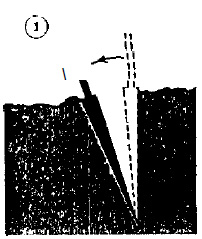
| Step 1
Insert the dibble straight down into the soil to the full depth of the blade (8"-10") and pull back on the handle to open the planting hole. DO NOT rock the dibble back and forth as this causes soil in the planting hole to be compacted, inhibiting root growth. |
 |
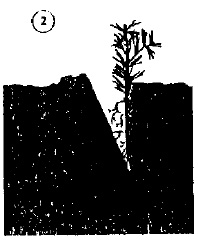
Step 2
Remove the dibble and push the seedling roots deep into the planting hole. Pull the seedling back up to the correct planting depth (the root collar should be 1 to 3 inches below the soil surface). Gently shake the seedling to allow the roots to straighten out. DO NOT twist or spin the seedling or leave the roots J-rooted. |
 |
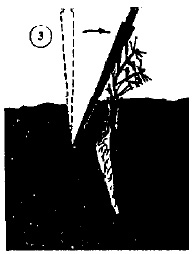
Step 3
Insert dibble behind seedling and twist it to help hold the seedling in place and close the top of the planting slit. |
 |
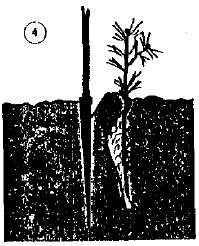
Step 4
Push the dibble down to the full depth of the blade. |
 |
Step 5
Pull back on the handle to close the bottom of the planting slit. Then push forward to close the top, eliminating air pockets around the root. |
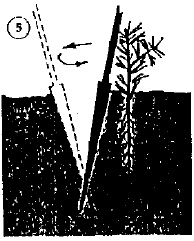 |
Step 6
Remove the dibble and close and firm up the opening with heel. |
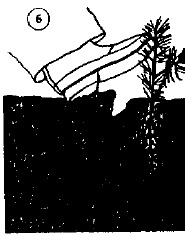 |
Planting Barefoot Seedling with Hoedad
Step 1
Strike blade almost vertically, full depth of the blade (8 -10"), into the soil. Pull up on the handle to break the soil loose at the bottom of the hole. |
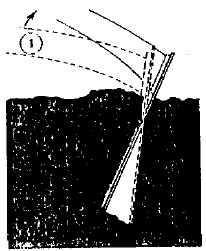 |
Step 2
Slide hand down handle almost to blade. Pull back and down on the handle to form a pocket on far side of blade. With the other hand, immediately roll the seedling roots into the pocket to the full depth of the hole. |
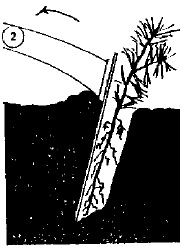 |
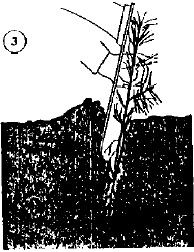
Step 3
Hold seedling in place while sliding the hoedad blade out of the hole. Loose soil should fall into the hole holding the seedling in place. |
 |
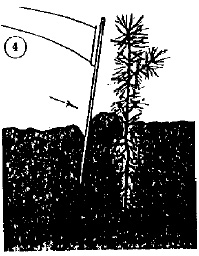
Step 4
Pull blade completely out of the hole and push soil against planted tree with the tip of the blade. |
 |
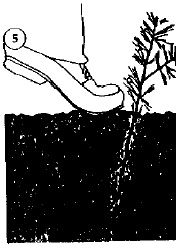
Step 5
Use foot to firm the soil against the seedling. Do not step on or bruise seedling with your foot. |
 |
 Lesson