Learn
Prescribed Burns
Introduction
The use of prescribed fire to manage forests is quite common across the Southeast, with an average of 8 million acres burned annually. This use of prescribed burning in the southeastern United States is why catastrophic wildfires are not an issue like they are in other parts of the country.
Most prescribed burns are in oak-pine and pine-type forests.
Landowners may utilize a single burn to accomplish a one-time goal or they may choose multiple burns to accomplish other objectives.
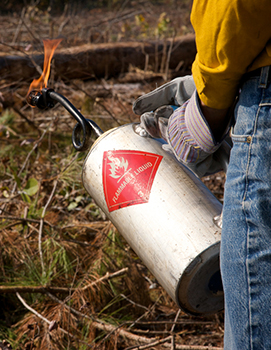
Goals of Fire Management
Landowners may use prescribed fire to accomplish such objectives as:
- Reducing hazardous fuel load to prevent catastrophic fire
- Controlling low-quality, undesirable competing vegetation to allow establishment of seedlings after plantings
- Control of pests – reducing the risk of fungus, diseases, or insect infestation of tree crops
- Ecological restoration – maintaining ecological function in fire-dependent ecosystems
- Maintenance of fire-dependent species – some species of plants require fire for seed germination
- Improve aesthetics – reducing brush and increasing the aesthetic quality of a stand, this may include creating more open spaces and increasing the presence of flowering plants and native pollinators
- Wildlife habitat improvement – enhancing wildlife habitat by increasing fruits/seeds, stimulating forage production, and creating openings in closed canopy forests, also opening up the midstory The layer of vegetation in a forest consisting of the trees whose height is between the smallest and the tallest. and understory The smaller tress, saplings, and sometimes shrubs that grow beneath the large trees in forests. areas more
- Increase range – increasing the amount of forage for grazing where cattle are present
- Increase access – increasing access by eliminating brush or logging residual
- Invasive species control – controlling certain invasive species
- Increasing water, soil nutrients, sunlight, and resource availability for already established trees
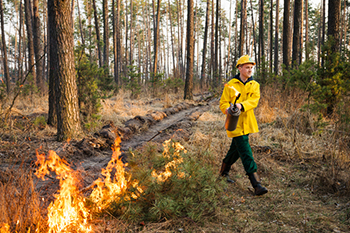
Fire Fuels
Prescribed fires act as a means to minimize fuels on the ground and thereby reduce the risk of wildfires.
Fuels begin to accumulate quickly in pine forests and to a lesser extent in hardwood forests. Fuel, also referred to as “rough,” can increase to hazardous levels in as little as 6 years.
In pine forests, needles continue to fall from mature trees and remain suspended in vines and shrubs. This provides a ladder for fire to climb into tree tops.
When a fire enters this forest, it no longer creeps along the ground. Instead the fire climbs up into the tops of trees and travels from treetop to treetop.
In situations like this, herbicides and/or mechanical removal of the midstory can act as a surrogate to fire.
Environmental Conditions
To reduce fuels with prescribed fire, environmental conditions must be appropriate. Appropriate conditions include high humidity and low temperature with ample previous precipitation. The most appropriate time occurs during the winter dormant season.
Ideally, prescribed burns to reduce fuels should be conducted every 3 to 4 years. These regular schedule of prescribed burns would help reduce fuel in the forest. The reduction of fuel reduces the risk of loss of economic and personal well being.
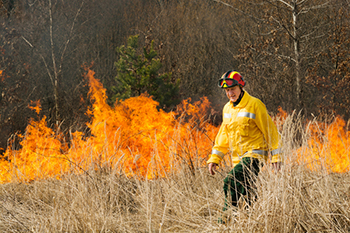
Prescribed Burns vs. Wildfire
Prescribed fire is a forest management tool used frequently in southern forests.
It should be conducted by certified trained professionals. The goal is to create specific Silvicultural or ecological conditions.
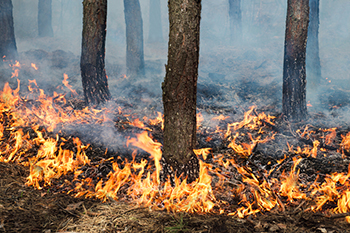
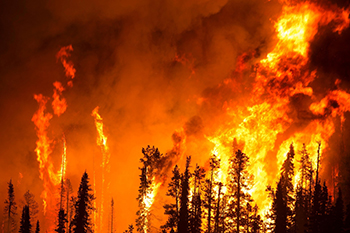
Wildfire is an unplanned fire that spreads uncontrollably across the landscape.
It may be the result of natural ignition (such as lightening), arson, or accident.
Prescribed Burn Plan
For prescribed burns, planning and preparation is the key to success. A prescribed burn plan should include:
- Burn unit description
- Vegetation and fuel descriptions
- Maps
- Weather prescription
- Smoke management plan
- Equipment and personnel
- Pre-burn considerations
- Burn prescription
- Contingency plan
- Fire evaluation plan
- Neighbor notification
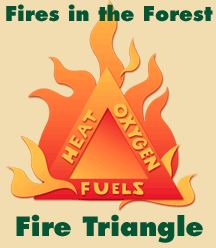
Heat + Oxygen + Fuel = Fire Triangle
Application
Watch Good Fire: Prescribed Burning from the U.S. Forest Service.