Learn
The Functions of Tree Parts
What's Your Name?
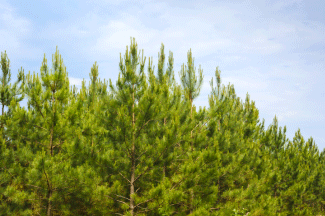
All plants and animals are divided into groups for classification. Binomial nomenclature is the formal system using Latin names that categorize each plant or animal by genus and species. For example the loblolly pine's formal name is Pinus taeda. Usually plants and animals are called by common names. We don't called the tree Pinus taeda; we call it loblolly pine. However, those names may vary from place to place and some may have multiple common names.
Dendrology
Dendrology is the identification and systematic classification of trees. Differentiation of trees is based on the distinguishing characteristics of each species. These characteristics are used to distinguish individual species of trees:
- Type - evergreen, deciduous
- Leaf - form, tip shape, leaf shape, arrangement, composition, margin (the outside edge) shape
- Bark - color, texture
- Fruit - pome (fruit containing the seed), berry, drupe, nut, capsule, samara, legume, nutlets (a small nut),
- Twig
- Form - height, shape
Descriptions
According to the Alabama Forestry Foundation, descriptions provided for most species include typical features commonly observed for that species. Occasionally however, attributes such as leaves, tree forms, and mature size can vary with site and stand conditions, age, and the view of the tree the observer had. Because this opportunity for variation does occur, it is important to look at multiple characteristics when identifying trees.
What Do We Need To Observe?
There are various parts of a tree that can tell us about the age, health, and function of the tree. When deciding what to observe, it is important to understand that not all parts of the tree are living. Those living parts of a tree, however, perform extremely complex functions. Those functions, in turn, allow trees to grow and survive for generations. Let's look at some of those living parts of the tree.
Roots
Tree root systems serve two purposes:
- anchor the tree
- absorb nutrients and water from the soil
Roots have tiny root-hairs that allow it to absorb nutrients and water from the soil. Just as in other parts of the tree, most of the root matter is not living and is dead. In fact, only the very tips of the roots are alive. At the very tips of the roots are living, growing cells that push a protective cap of dead cells through the soil. If you were to add up all of the roots that are beneath the soil you would find hundreds of miles in the root system.
Leaves or Needles
Trees are able to take CO2 (carbon dioxide) absorbed through the leaves /needles from the air, H2O (water) absorbed from the roots, and sunlight and create photosynthesis (the process of turning carbon dioxide and water into food) with the help of chlorophyll (a green pigment present in all green plants).
Sugar is then made and pushed back to the living cells throughout the tree so that it can breathe and create energy for the tree to grow. This explains the process of photosynthesis, but how and why do leaves change colors in the fall?
Changing Leaf Color
Most people know that in the fall, hardwood leaves change colors and fall off the tree. But how and why? What causes the leaves to change color? Most people think the changing temperature is the trigger that sets leaf color change in motion. In reality it is the changing rhythm of the days and nights. As days grow shorter, a hormone is released in the tree which restricts the flow of sap to each leaf.
Why does one tree turn gold, another red, and yet another orange? The answer is in the sap. The chemical composition of each tree's sap determines what fall color its leaves will turn.
What about conifers? If you have ever seen a pile of pine needles you know they don't stay on the tree forever. While it is less dramatic than hardwoods, most conifers lose their three-year old needles in the fall.
Cambium
The cambium extends in a single layer from the tips of the branches to the roots. These cells add thickness to the tree. If you remember, we learned in the last lesson that it is responsible tree growth and forming annual rings. The Cambium layer ultimately becomes bark and wood on the tree and adds thickness to the tree.
Leaf Buds
The leaf buds are the growth on the tree that gives the tree height. This is why if you carve your name into a tree, when you come back you find that your name has not gotten any higher on the tree. A tree grows from the top, not the bottom. So where you carved your name will remain at the same height. The growth of the leaf buds is coordinated with the growth of the cambium layer and the leaf tips. A tree grows in height from the leaf bud. While it grows in thickness from the cambium layer. Both of these growth activities occur at the same time.
Seeds
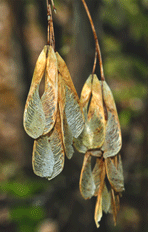
Tree seeds from both conifers and deciduous trees are created to aid in promoting growth of the next generation. Seeds are created in a way so that they are carried away from the parent plant. This is done so that there is not competition for growing resources. There are several natural mechanisms that are used for moving the next generation of seeds. These include, but are not limited to:
- wind
- animals
- water
Reproductive Cycle
Watch the Reproductive Cycle of a Pine Tree. You will need the information in the video to complete 2.02 Pinecones.
Tree Ring
Tree rings, sometimes called annual rings, will not tell you the type of tree, but they will tell you other things about the tree, like the age of the tree, if the tree has suffered through droughts, insect infestations, or fires. You may be able to tell if a tree was too crowded by other trees, or if something was leaning on one side of the tree for an extended period of time.
Counting the rings will tell you the age, that is why the rings are called annual rings. The darker rings represents slower growth in the summer months. The light rings, which are larger, represents faster growth in the spring. In addition, tree rings that vary in size can indicate a number of challenges that the tree may have faced in its lifetime.
Read Reading the Rings of a Tree to learn how to tell if a tree has faced challenges such as drought or fire, then see what you can determine about the tree pictured.
Ring #1:
How old do you think this tree was when it was cut?
What else do you notice?
Any scarring?
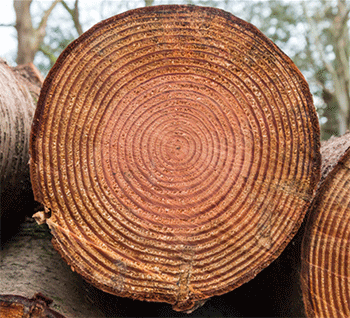
- It looks like there are 19 to 20 rings. This tree was between 19 and 20 years old!
- The rings are pretty evenly sized. It doesn't appear the tree suffered through drought or fire.
- We can easily see the difference between summer and winter growth. (Dark and light rings)
Ring #2:
How old do you think this tree was when it was cut?
What else do you notice?
Any scarring?
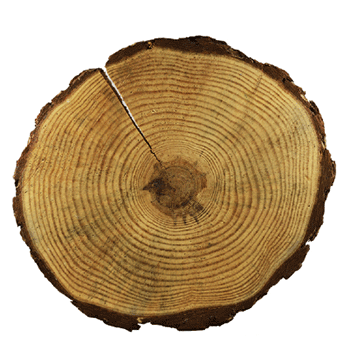
- The rings are so small in the center it is really difficult to count them! I would guess this tree is at least 30 years old.
- These very small rings means this tree had a rough start in life. Was it a drought or insects?
- Looks like something may have been leaning on it over here.
- These were good years, with healthy growth.
Ring #3:
How old do you think this tree was when it was cut?
What else do you notice?
Any scarring?
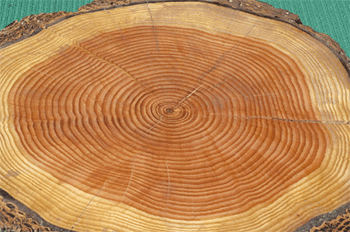
- Looks like there are about 46 rings in this one! Wow!
- There are some thin rings here, indicating some drought years.
- This side is kind of flat. Maybe something was leaning on it here for awhile.
- This one has a great contrast in color between the heartwood and sapwood.
- Most of these rings are pretty wide. Seems like this tree had good rain most of its life.