Learn
Environmental Factors
Environmental factors influence rates of decay and insect activity and growth rates. For example, a body will decay slower in a cold, dry climate than it would in a hot and humid one. And generally, insects grow slower and are less active in colder climates than in warmer ones.
When determining the postmortem interval, forensic investigators must take environmental factors into account.
Estimating the Post Mortem Interval
Watch Estimating the Post Mortem Interval, part 6 - Environmental Factors to learn how environmental factors influence rates of decay.
Open Estimating the Post Mortem Interval, part 6 - Environmental Factors in a new tab
Knowledge Check #1
A body located in a desert will decompose slower due to the lack of moisture.
- True
- False
Answer: b. False. A body in the desert decomposes much quicker due to the increased temperature.
Knowledge Check #2
A buried body decomposes ________blank.
- faster
- slower
Answer: b. slower
Insect Activity
In the previous lesson, you learned how entomologists utilize insect activity to estimate PMI. Insect activity is greatly influenced by the amount of thermal energy available.
Insects will grow at a different rate depending on the temperature of their environment. Some insects cannot survive when exposed to extreme temperatures temperatures that are very high or very low . Generally, insects grow slower and are less active under cold conditions and they grow faster and are more active when exposed to warmer temperatures. So, if a body is discovered outdoors, the insects feeding on that body will have variable growth rates based on fluctuations in daily temperature.
Fly Life Cycle and Thermal Energy
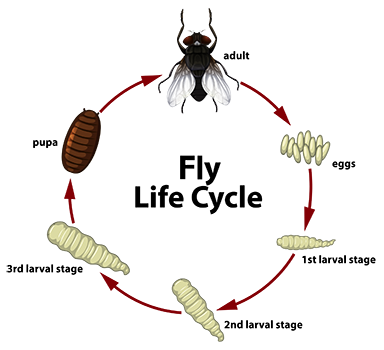
The black blow fly (Phormia regina) is the most common insect found on a decomposing body. This insect survives and grows best when the environment temperature ranges from 55°F to 95°F. As the fly grows, it moves through different stages of the life cycle.
To advance to the next growth stage, an insect requires a certain amount of thermal energy, or energy in the form of heat. The insect will receive more thermal energy as time passes. Each day that an insect is feeding and living on a body, it will receive more thermal energy from its environment.
We can determine how much thermal energy that an insect has received in a day by multiplying the environmental temperature by the number of hours in a day. We call these heat units accumulated degree hours (ADH).
For example, if the average temperature on a given day is 70°F, then after one full day (24 hours), the insect will have received 1,680 heat units.
Temperatures × Number of hours = Total heat units in hours.
70°F × 24 hours = 1680 ADH.
In death investigations, bodies are commonly found after they have been exposed to insect activity for several days or weeks. As a result, it is necessary to estimate the total amount of thermal energy that has been received over a longer period.
For example, if the body of a missing person is discovered on July 7th, and that person was reported missing on July 1st, then a researcher would want to collect insects from the body and calculate ADH based on the temperature data for the week in question.
Calculating ADH
Watch Calculating Accumulated Degree Hours to help you better understand the method forensic investigators use during this process.
Open Calculating Accumulated Degree Hours in a new tab
PMI Estimation
We can use accumulated degree hours to assist in PMI estimation Postmortem Interval (PMI) because fly life cycles are predictable and have been documented through rigorous scientific experimentation. Black blow flies will grow in environments with temperatures between 55°F and 95°F. The insect will only advance to the next stage in the life cycle after receiving a given amount of thermal energy. The table below provides information about the amount of thermal energy needed for a blow fly at each stage of development. Note that there is a range of energy that may be needed for the transition to the next stage.
Estimated Thermal Energy Requirements for the Life Cycle of the Black Blow Fly
| Stage in the Life Cycle | Thermal Energy Required (ADH) |
|---|---|
| Egg | Less than 950 |
| 1st Instar | 950 - 1770 |
| 2nd Instar | 2,280 - 4,484 |
| 3rd Instar | 3,990 - 9912 |
| Pupa | 15,010 - 23,364 |
| Adult Fly | 33,440 – 38,468 |
Knowledge Check #3
Let's look at how entomologists can use the ADH and the thermal energy requirements to determine the age of flies on a discovered body.
For example, imagine the body of a missing person is discovered on July 7th and that person was reported missing on July 1st. Entomologists would collect insects from the body and calculate ADH based on the temperature data for the week in question.
Table 1: Accumulated Degree Hour Calculations
| Day | Average Temp. | ADH Calculation | Accumulated Degree Hours | Calculating ADH Totals (Add up ADH values) | Total ADH |
|---|---|---|---|---|---|
| July 1 | 78 | 78° × 24 | 1872 | 1872 + 0 (ADD for 1 day) | 1872 |
| July 2 | 80 | 80° × 24 | 1920 | 1872 + 1920 | 3792 |
| July 3 | 85 | 85° × 24 | 2040 | 3792 + 2040 | 5832 |
| July 4 | 76 | 76° × 24 | ___blank | ___blank | ___blank |
| July 5 | 90 | 90° × 24 | ___blank | ___blank | ___blank |
| July 6 | 83 | 83° × 24 | ___blank | ___blank | ___blank |
| July 7 | 74 | 74° × 24 | ___blank | ___blank | ___blank |
Now it's your turn! Complete the remaining portion of the table by calculating ADH each day and adding it to the previous day's total.
Check Your Answers:
| Day | Average Temp. | ADH Calculation | Accumulated Degree Hours | Calculating ADH Totals (Add up ADH values) | Total ADH |
|---|---|---|---|---|---|
| July 1 | 78 | 78° × 24 | 1872 | 1872 + 0 (ADD for 1 day) | 1872 |
| July 2 | 80 | 80° × 24 | 1920 | 1872 + 1920 | 3792 |
| July 3 | 85 | 85° × 24 | 2040 | 3792 + 2040 | 5832 |
| July 4 | 76 | 76° × 24 | 1824 | 1824 + 5832 | 7656 |
| July 5 | 90 | 90° × 24 | 2160 | 7656 + 2160 | 9816 |
| July 6 | 83 | 83° × 24 | 1992 | 1992 + 9816 | 11808 |
| July 7 | 74 | 74° × 24 | 1776 | 1776 + 11808 | 13584 |
Using this chart, entomologists can then determine which stage of the life cycle should have been reached each day. For example, on July 1, the thermal energy requirement was met for the eggs to hatch and develop into the 1st instar larva. By July 2nd, the 2nd instar larva could have developed.
Knowledge Check #4
If the body was placed in this location on July 1, what stage would you expect the blow flies to be in on July 7?
- 1st instar
- eggs
- 3rd instar
- pupa
Answer: c. 3rd instar.
Knowledge Check #5
Would you surprised to find pupa on the body?
- Yes, there has not been enough thermal energy for them to develop.
- No, pupa may have crawled into the body from another location.
Answer: a. Yes, there has not been enough thermal energy for them to develop.
Credits
"Forensic Science: Estimating Postmortem Interval" by Candice Chambers, North Carolina School of Science and Mathematics is licensed under CC BY-SA 4.0 / A derivative from the original work.