Learn
DNA Collection and Analysis
Human Cells Used for DNA Evidence
DNA is unique to each individual. DNA is found in all human cells except mature red blood cells, which do not contain a nucleus. Only a few cells are needed to obtain sufficient DNA evidence for analysis.
DNA Evidence
This table from the National Institute of Justice's article "DNA Evidence: Basics o fIdentifying, Gathering and Transporting" lists common items of evidence that may contain DNA, including where the DNA may be found on the evidence and the biological source of the cells.
| Evidence | Possible Location of DNA on the Evidence | Source of DNA |
|---|---|---|
| baseball bat or similar weapon | handle, end | sweat, skin, blood, tissue |
| hat, bandanna, or mask | inside | sweat, hair, dandruff |
| eyeglasses | nose or earpieces, lens | sweat, skin |
| facial tissue, cotton swab | surface area | mucus, blood, sweat, semen, ear wax |
| dirty laundry | surface area | blood, sweat, semen |
| toothpick | tips | saliva |
| used cigarette | cigarette butt | saliva |
| stamp or envelope | licked area | saliva |
| tape or ligature | inside/outside surface | skin, sweat |
| bottle, can, or glass | sides, mouthpiece | saliva, sweat |
| used condom | inside/outside surface | semen, vaginal or rectal cells |
| blanket, pillow, sheet | surface area | sweat, hair, semen, urine, saliva |
| "through and through" bullet | outside surface | blood, tissue |
| bite mark | person's skin or clothing | saliva |
| fingernail, partial fingernail | scrapings | blood, sweat, tissue |
Crime Scenario
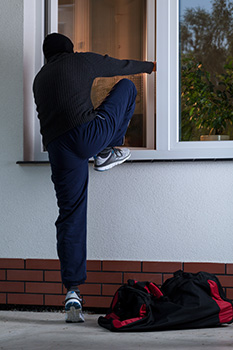
Think about this scenario: A person person breaks into your neighbor's home by forcing open a window from the outside. Police find a black beanie, or knit cap, by the window, or point of forced entry and confirm with your neighbors that the hat isn't theirs. CSIs find several strands of hair inside the cap and one of them has the root with tissue still attached.
DNA Profile
Through forensic analysis of the human head hair, a DNA profile is made and the perpetrator who broke into the home is identified.
Finding someone's DNA in a location where the material isn't supposed to be – like in this example -- is the best case scenario for DNA evidence collection (NFSTC)!
DNA Contamination
Because only a few cells are needed to obtain DNA evidence, only a few cells are needed to contaminate DNA evidence. Investigators could inadvertently contaminate evidence with their own skin cells, saliva, or sweat if they work without the proper precautions, including gloves and masks. As with all evidence, a chain of custody is recorded for collected DNA samples. If laboratory analysis reveals that the sample may have been contaminated, analysts can collect DNA samples from those along the chain of custody for comparison.
Collecting DNA Evidence
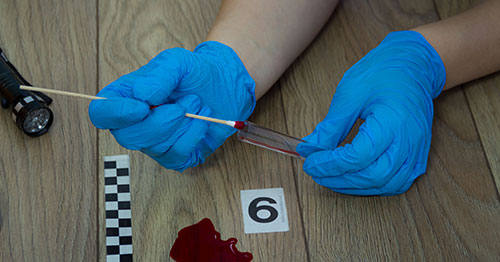
When collecting DNA evidence, officers should describe where the evidence was found and whether it was collected wet or dry. Direct sunlight, warm conditions, and humidity can degrade DNA. Samples should not be stored in places that may get hot, such as the trunk of the police car. If possible, it is best to freeze samples or allow them to dry prior to storage. If liquid samples are collected, they should be refrigerated or stored in an insulated container.
Knowledge Check #1
Collecting, packaging, and transporting DNA are examples of evidence _________. Once the DNA arrives at the lab, the work of ___________ begins.
- analysis; processing
- processing; analysis
Answer: b. processing; analysis. Collecting, packaging, and transporting DNA are examples of evidence processing. Once the DNA arrives at the lab, the work of analysis begins.
Short-tandem Repeats
In most cases, DNA samples are analyzed using unique repeating patterns in the non-coding portion of DNA that does not code for specific proteins region of the DNA. These patterns are known as short-tandem repeats (STRs) and can be measured to create a DNA profile or DNA fingerprint for an individual.
In the United States, thirteen locations along the autosomal DNA have been chosen for STR analysis. Analyzing the same 13 locations each time allows for consistent DNA analysis across states and the creation of searchable databases. The statistical probability of two people having matching markers at all 13 locations has been found to be 1 in 575 trillion.
13 Core STR Locations
This image shows the location and “names” of the 13 core STR locations as well as the locations (AMEL) used to determine whether the DNA came from a male or female (AMEL).
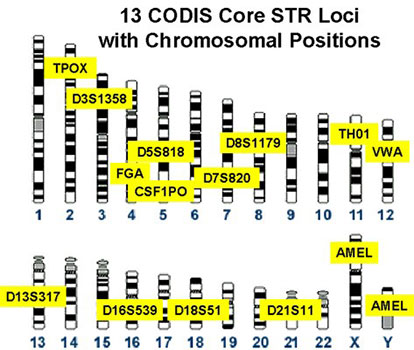
One of the 13 locations is found on human chromosome 7 and known as D7S280. The repeating sequence at this location is “GATA.” A DNA sample may have anywhere from 6 to 15 tandem in a row repeats of the “GATA” sequence.
Knowledge Check #2
Look at the sequence below. How many tandem repeats of "GATA" are present?
| 1 | aatttttgta | ttttttttag | agacggggtt | tcaccatgtt | ggtcaggctg | actatggagt |
| 61 | tattttaagg | ttaatatata | taaagggtat | gatagaacac | ttgtcatagt | ttagaacgaa |
| 121 | ctaacgatag | atagatagat | agatagatag | atagatagat | agatagatag | atagatagat |
| 181 | agatagtttt | tttttatctc | actaaatagt | ctatagtaaa | catttaatta | ccaatatttg |
| 241 | gtgcaattct | gtcaatgagg | ataaatgtgg | aatcgttata | attcttaaga | atatatattc |
| 301 | cctctgagtt | tttgatacct | cagattttaa | ggcc |
- 5
- 15
- 22
- 301
Answer: b. 15.
CODIS
In 1997, the FBI selected these 13 STR locations as the core of the United States national DNA database, known as CODIS Combined DNA Index System . The database currently contains over 14 million profiles. Investigators will compare unknown samples from the crime scene to samples collected from suspects as well as others at the scene (to rule out contamination). If there are no known suspects, investigator can also search CODIS to find a matching DNA profile.
Forensic Science in the Crime Lab
Hear one forensic scientist share what she loves about her job and see how DNA evidence is analyzed, including the resulting DNA comparison in the following video:
Open Forensic Science in the Crime Lab in a new window
Note: The presentation may take a moment to load.
Knowledge Check #3
According to the video, the role of the forensic scientists is to present the information to the _____ and allow them to decide what happened.
- jury
- judge
- manager
- investigators
Answer: a. jury
Knowledge Check #4
Place the steps of DNA analysis in th proper order.
- DNA extraction (removing DNA from the sample)
- Genetic analyzer (produces DNA profile)
- Analyst compares suspect and unknown sample at each location.
- DNA amplification (making multiple copies of the DNA)
Answer:
- DNA extraction (removing DNA from the sample)
- DNA amplification (making multiple copies of the DNA)
- Genetic analyzer (produces DNA profile)
- Analyst compares suspect and unknown sample at each location.
How DNA Results are Interpreted
Open A Simplified Guide to DNA Evidence: How It's Done from A Simplified Guide to Crime Scene Investigation by National Forensic Science Technology Center. Scroll down and read the section "How the Results are Interpreted."
Be sure to:
- Read the sub-sections "Is the suspect included?" and "Partial Profiles."
- Look at the graphs.
- Learn the terms electropherogram and partial profile.
Knowledge Check #5
How many locations are typically analyzed to create a DNA profile for a suspect or unknown sample?
- 6
- 13
- 18
- 22
- The entire genetic sequence is analyzed and stored on CODIS.
Answer: b. 13
Knowledge Check #6
If there is only one peak at a certain location, this means that ___________.
- the process needs to be repeated
- the DNA is degraded
- the person inherited this gene from only one parent
- the person inherited the same allele from both parents
Answer: d. the person inherited the same allele from both parents.
DNA Limitations
The first crime solved in the United States using DNA was the case of Colin Pitchfork in 1988, which was summarized in the previous lesson. Since that time, due to its accuracy and reliability, DNA has become an invaluable forensic tool. It is not, however, without limitations.
DNA profiles are expensive to obtain and provide little information if there is not a suspect to compare the profiles to. Labs can be backlogged for months, delaying investigations. DNA evidence may be contaminated or degraded, resulting in a partial profile.
CSI Effect
Investigators must not rely exclusively on DNA evidence. Jurors, however, have come to expect DNA evidence (something known as the CSI effect), even in cases where other evidence is more valuable. If there is no usable DNA evidence in a case, expert witnesses should take a moment to explain this to the jury.
Knowledge Check #7
Which of the following are common limitations to DNA evidence?
- partial profiles due to degraded samples
- lack of suspects to compare evidence to
- back-logged labs
- contaminated samples
- All of these are limitations to the usefullness of DNA evidence.
Answer: e. All of these are limitations to the usefullness of DNA evidence.
Credits
United States, Department of Justice, Office of Justice Programs, National Institute of Justice. "DNA Evidene: Basics of Identifying, Gathering and Transporting," 8 Aug. 2012, https://nij.ojp.gov/topics/articles/dna-evidence-basics-identifying-gathering-and-transporting.
NFSTC. "How It's Done: DNA Evidence." A Simplified Guide to Crime Scene Investigation, National Forensic Science Technology Center, September 2013, www.forensicsciencesimplified.org/dna/how.html.