Lab
Background Information
Scenario
You work with the city water department. Local citizens have complained that a new factory is dumping pollutants into the river. The factory says that the water they discharge into the river is free of any dangerous chemicals. You have run some broad tests of temperature, pH, and mercury and have not yet found any pollutants in the river. Your job is to use bioassessment to determine if more expensive chemical tests are needed.
What is bioassessment?
Bioassessment is another method that is used by scientists to determine the overall quality of a source's water. With bioassessment, scientists study the types and numbers of living organisms present in the water. This method does not give you exact measurements of the different areas of the water's chemistry. Bioassessment does allow you to see a water source's overall water quality. Certain organisms are very sensitive to pollutants and the presence and number of these organisms in the water gives scientists a good idea of water quality. The poorer the quality of water the fewer of types and numbers of organisms that can live in it.
The major types of organisms that are used to determine water quality are benthic macroinvertebrates. Macroinvertebrates are organisms that are large enough to be seen with the naked eye and don't have a backbone. Arthropods are one example of macroinvertebrates. Benthic refers to the bottom of bodies of water. These are organisms such as insect, insect larvae, crayfish, worms, and leeches that live mostly on the bottom of the river, stream, lake, or pond and are primarily stationary.
Macroinvertebrates
In order to do a bioassessment of the river, you need to know what species you should expect to find in the area and their sensitivity to pollution. Choose each macroinvertebrate on the next slide to examine the species and learn about its sensitivity to pollution. The macroinvertebrates have a sensitivity index ranging from 0 to 10. Macroinvertebrates with a rating close to 0 are very sensitive to pollutants. Those with a sensitivity index closer to 10 are tolerant of pollutants.
Examine the Species
Common Name: Green Caddisfly larva
Scientific family: Rhycophilidae
Sensitivity Index: 0
More information:
Macroinvertebrates.org: Free-living, Green Caddisflies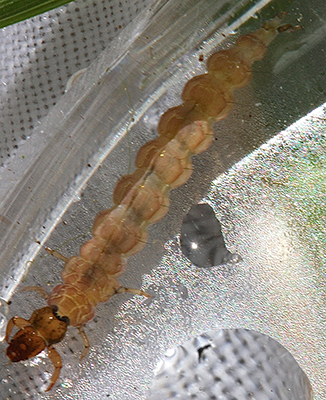
Common Name: Armored mayfly
Scientific family: Baestiscidae
Sensitivity Index: 1.4
More information:
Macroinvertebrates.org: Armored Mayfies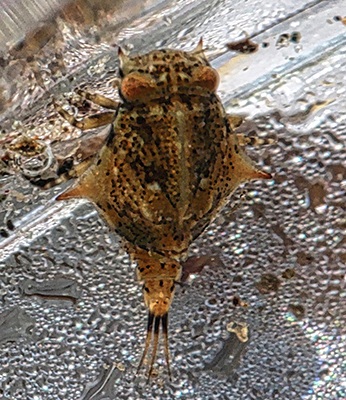
Common Name: Diving beetle
Scientific family and genus: Dytiscidae Agabus
Sensitivity Index: 8
More information:
Macroinvertebrates.org: Predacious Diving Beetles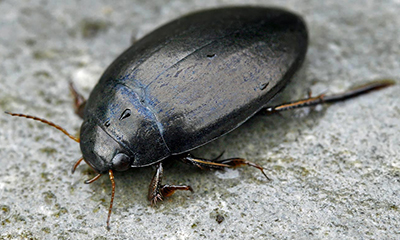
Common Name: Little green stonefly
Scientific family and genus: Chloroperlidae Alloperla
Sensitivity Index: 1.4
More information:
Macroinvertebrates.org: Green Stoneflies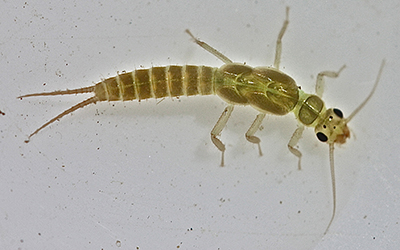
Common Name: Pitot-tube caddisfly
Scientific family: Phylocentropus
Sensitivity Index: 5.6
More information:
Macroinvertebrates.org: Pitot-tube Caddisflies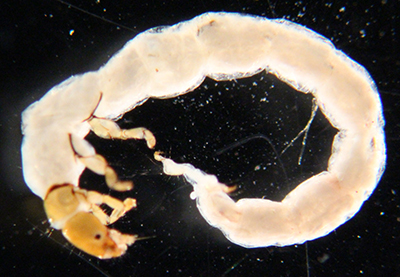
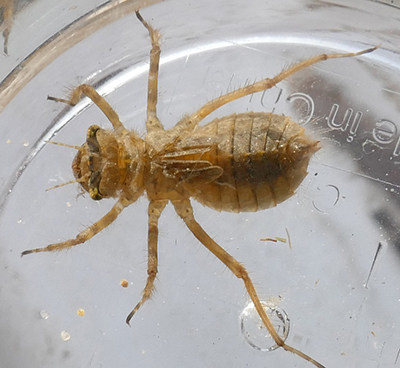
Common Name: Skimmers
Scientific family: Libellula
Sensitivity Index: 9.8
More information:
Macroinvertebrates.org: Skimmers
Common Name: Northern casemaker caddisfly
Scientific family: Pycnopsyche
SensitivityIndex: 2.5
More information:
Macroinvertebrates.org: Northern Casemaker Caddisflies
Knowledge Check # 1
Identify the macroinvertebrate pictured below.
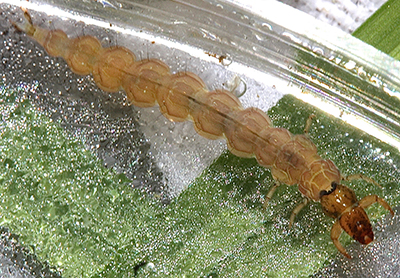
- little green stonefly
- green caddisfly larve
- armored mayfly
- diving beetle
Answer: The correct answer is b. free-living green caddisfly. Let’s try another.
Knowledge Check # 2
Identify the macroinvertebrate pictured below.
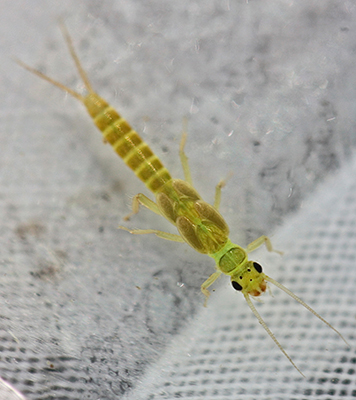
- little green stonefly
- northern casemaker caddisfly
- pitot-tube caddisfly
- skimmer
Answer: The correct answer is a. little green stonefly. Let’s try another.
Knowledge Check # 3
Which of the macroinvertebrate below would you be least likely to find in polluted water?
- armored mayfly
- diving beetle
- skimmer
Answer: The correct answer is c. armored mayfly. The armored mayfly has a lower sensitivity index, so it is less likely to be found in a polluted pool. Let’s move on to th next step.
The Water Samples
You are now ready to collect your water quality samples. You are told to take two samples - one upstream from the factory and one downstream from the factory.
Why do you need the two samples?
Answer: You need two samples so you have a control. The water upstream from the factory could not have any pollution from the factory, so it will act as a comparison for the downstream sample. If the macroinvertebrates in both samples are similar, you can conclude that the factory is not polluting the river.
Upstream Site
You have taken several samples from site one. Now it is time to go back to the lab and identify the organisms you see.
Upstream Knowledge Check
Match the macroinvertebrate with the correct image.
Macroinvertebrate:
- green caddisfly larva
- armored mayfly
- diving beetle
- skimmers
- pitot-tube caddisfly
Images:
Answers:
- armored mayfly
- skimmers
- pitot-tube caddisfly
- green caddisfly larva
- diving beetle
Upstream Data
Now that you have sorted, identified, and counted all your samples, you have the following data:
| green caddisfly larva | armored mayfly | pitot-tube caddisfly | diving beetle | skimmer |
| 23 | 31 | 15 | 9 | 27 |
Record this data. It will be your control comparison for the downstream sample.
Downstream Site
You have taken several samples from site two. Now it is time to go back to the lab and identify the organisms you see.
Downstream Knowledge Check
Match the macroinvertebrate you found at the upstream site with the correct image.
Macroinvertebrate:
- armored mayfly
- diving beetle
- skimmers
- pitot-tube caddisfly
Images:
Answers:
- armored mayfly
- skimmers
- pitot-tube caddisfly
- diving beetle
Downstream Data
Now that you have sorted, identified, and counted all your samples, you have the following data:
| armored mayfly | pitot-tube caddisfly | diving beetle | skimmer |
| 7 | 9 | 7 | 24 |
Record this data. It will allow you to draw conclusions about potential pollution.
Conclusion
It is time for you to form your conclusion. Based on the evidence, do you think the factory could be releasing pollutants into the river? Should you run additional chemical tests to check?
Support your conclusion with evidence from your testing sites and explain your reasoning.
Works Cited
"Agabus sp." by Entomart is licensed under ©entomart
"Armored mayfly, Baetisca berneri" by Bob Henricks is licensed under CC BY-SA 2.0
"Free-living caddisfly larva, Rhyacophila fenestra ledra" by Bob Henricks is licensed under CC BY-SA 2.0
"Green stonefly, genus Alloperla" by Bob Henricks is licensed under CC BY-SA 2.0
"Libellula quadrimaculata" by Wim Rubers is licensed under CC BY-SA 3.0
"Phylocentropus larva" by Dmccabe is licensed under CC BY-SA 3.0
Unless otherwise noted, all text and images featured in this presentation are original works created by ACCESS, available by public domain, CC BY-NC-SA license, and/or licensed from iStock or Articulate.
 |