Learn
Plot
Plot is a literary device that defines the structure, or framework, of a story. Plot can be told in a number of ways:
- chronological orderarranged in the order it happened ,
- flashbackan interjected scene or point that takes the narrative back in time , or
- in media resin the middle of things .
Aristotle and Freytag
Aristotle and Gustav Freytag introduced the plot pyramid. Aristotle described the organization of plot as having a basic beginning, middle, and end pattern.
Hoever, Freytag added more detail to the pyramid by introducing the concepts of:
- exposition,
- rising action,
- climax,
- falling action, and
- denouement.
Freytag's Pyramid
Review each part of Freytag's Pyramid below.
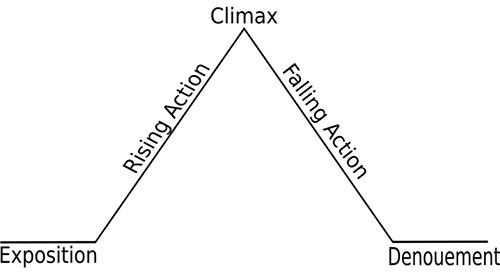
Exposition: The exposition introduces the readers to the characters and describes the time and place of the setting.
Rising Action: The rising action is where the conflict gets more exciting and the story builds around this struggle.
Climax: The climax is the moment of greatest excitement or tension in the story. It is also known as the crisis.
Falling Action: The falling action is where the events happen as a result of the climax, and the reader knows that the story will soon end.
Denouement: The denouement (pronounced day-noo-moh) is a French word literally meaning the end. All loose-ends are tied and resolved by the characters or explained by the author. The character solves the main problem or conflict, or someone solves it for him or her.
