Lesson 8.02: Name, Rank, and Serial Number
British Slang
Matching British slang with American words!
A “kip” is a nap
“Bee’s knees" is awesome
“Wicked” means cool
A “Loo” is the same as a toilet
Your “chap” is your (male) friend
A “bugger” is a jerk
The “bog roll" is toilet paper
“Nosh” is the same as food
“Anti-clockwise” instead of counter-clockwise
“Chips” are fries
“Rubbish” is the same as garbage
A “lift” is an elevator
“Petrol” is gasoline
“Telly” is the same as a TV
Roald Dahl
Do you remember?
When the United States engaged in WWII in 1941, after the Japanese attacked Pearl Harbor, Hawaii, we joined England and France to fight Germany, Italy, and Japan. Do you remember? We studied about Jeanne Wakatsuki Houston and her years in a Japanese internment camp in the U.S.
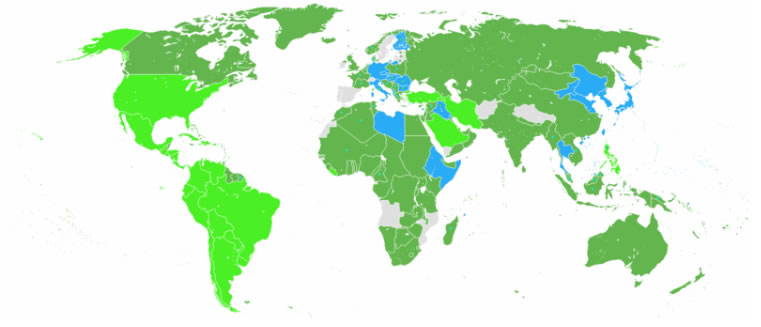
Map of the world: light and dark green: Allied countries
blue: Axis countries
gray: neutral countries
Geneva Convention
Earlier in 1929, forty-eight different governments signed an agreement at the Geneva Convention that promised any prisoner of war would be given humane treatment. As one can imagine, both sides, at times, failed to follow the rules of the Geneva Convention. As soldiers were trained, they all learned the importance of not divulging key information to the enemy. If captured, a soldier was supposed to remain calm and to give only his name, his rank, and his military serial number.
For example, a soldier such as the pilot in the story we will review by Roald Dahl could state, Peter Williamson, Squadron Leader, 972457.
Roald Dahl
Roald Dahl, the author of "Beware of the Dog," served as a fighter pilot, himself, in the British Royal Air Force during WWII, just as Prince William and Prince Harry do today. Dahl's plane was shot down over the Libyan Desert, and he spent eighteen weeks in a German hospital. Therefore, as a writer, Dahl used his experiences in war to generate ideas for his short stories. Although you may not have heard of Dahl, you may have read one of his children's books, James and the Giant Peach, or you may have seen a movie based on his novel, Charlie and Chocolate Factory. Did you ever see the film, "Willie Wonka and Chocolate Factory"? It is one of my favorites.
Fighting For France
We will refer to Dahl's "Beware of the Dog" to get some background information. First of all, during WWII the Germans occupied France. England and the U. S. fought to free France from Germany. It was common for fighter pilots to leave an air field on the southern coast of England, fly a mission to northern France, and return home.
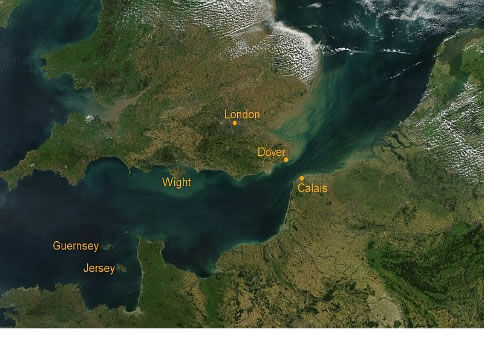
Map of Europe
Each flight between England and France, the fighter pilot would cross the English Channel, the body of water that separates England from France. Since this type of flight is what Dahl's main character is engaged in, we learn our story has a historical setting. Events in the story may be fictional, but the setting could have happened, according to history.
"Beware of the Dog"
Read "Beware of Dog." You will do this through the Open Library, so you will need to follow the steps below.
- Login with username access_student and password access
- Select Read Online
- Search for 493
- Click on the icon to begind reading the story.
Analysis
Lancasters
The British flew Lancasters, the Americans, Flying Fortresses, and the Germans, Junker 88s (JU-88). (You will need to remember which country flew which plane for this lesson.)
As Dahl's story opens, the fighter pilot, flying a Lancaster, is struggling to return to southern England, to his town of Brighton. Remember, the Royal Air Force from England fly the Lancasters. When Williamson crashes, the next time he regains consciousness, the nurse tells him he is in Brighton and explains the pilot's right leg had to be amputated.
Consider: Why is he relieved when the nurse tells him he is in Brighton?
Answer: He was relieved because after he was shot in his plane, he was unsure whether he crashed in England or German-occupied France.
German Planes
The pilot begins to become suspicious that something is not quite right. First of all, he notices the nurse and the doctor seldom make eye contact with him. Next, he notices the nurse to be rather large, tall, and blonde. Most British women do not have these characteristics.
As the story progresses, Williamson discovers more clues. First, he notices a fly buzzing around his hospital room and, then, hears the sound of Ju-88s, German planes, flying overhead.
Consider: Why would German planes be flying over Brighton?
Answer: They might be bombing Brighton. But if they were, sirens would be sounding and he would hear explosions.
Garde au Chien
For the last clue, the pilot manages to hobble to the window to look outside. It is then that he discovers a sign in a neighboring yard which reads, "Garde au Chien." This sign might be normal, "Beware of the dog," but it is written in French. There would be no such signs in England. Now that Williamson has put together the clues, he realizes he is in occupied France, an area controlled by the Germans.
When questioned, again, why do you suppose he gives only his name, rank, and serial number? Do you recall the pilot's information shared in the introduction?
Consider: Why would the soldier question Williamson, anyway?
Answer: An English soldier might need to, but he would probably already know some of the information asked.
Prediction
Dahl's story ends at this moment with a cliff hanger. We do not know the future of Peter Williamson.
Consider: Predict what you think will happen to the pilot?