Learn
Area of Irregular Shapes
To find the area of irregular shapes, the first thing to do is to divide the irregular shape into regular shapes that you can recognize such as triangles, rectangles, circles, and squares.
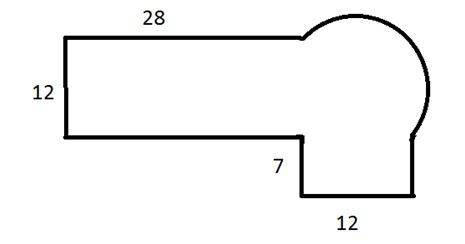
We can divide the irregular shape above into regular shapes, shown below.
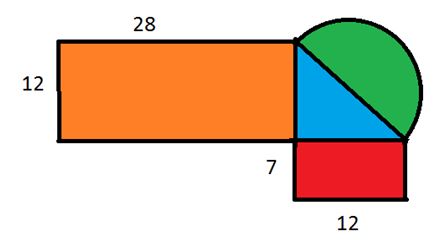
Then, you find the area of each of these shapes and add them together. On this particular shape below, you will have to use the Pythagorean Theorem to find the diameter of the semi-circle.
Find the areas of the regular shapes:
- Find the area of the orange rectangle:
- A = lw
- A = 12(28)
- A = 336
- Find the area of the blue triangle:
- A = ½ bh
- A = ½ (12)(12)
- A = 72
- Find the area of the red rectangle:
- A = lw
- A = 12(7)
- A = 84
- Use Pythagorean Theorem to find the diameter of the semi-circle:
- a2 + b2 = c2
- 122 + 122 = c2
- 144 + 144 = c2
- 288 = c2
- √288 = √c2
- 12√2 = c
- Remember to half the diameter to get the radius and find the area of the green semi-circle:
- A = ½ π r2
- A = ½ π (6√2)2
- A = 36π
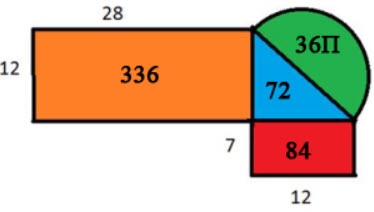
- Add all of the areas together to find the area of the irregular shape:
- 336 + 72 + 84 + 36π = ____
- 492 + 36π
See how each of the irregular shapes make up the overall irregular shape and how the different areas can be combined.
Surface Area of Irregular Shapes
On this shape we are going to calculate the surface area. The surface area is the sum of the area of all of the faces.
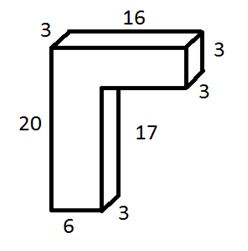
Before we begin, we must determine how many faces there are.
How many faces do you think this shape has?
Answer: The shape has 8 faces.
It may help to make a net of this shape when determining faces. A net is a flattened out three dimensional solid.
Imagine you cut enough edges of the shape below so that it would lay flat. The net image here is an example of what you end up with.
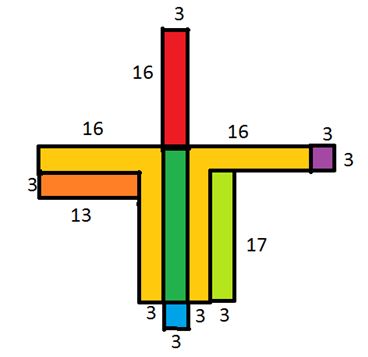
Find the surface area of each part of the net.
- Find the area of the red rectangle:
- A = lw
- A = 3(16)
- A = 48
- Find the area of the orange rectangle:
- A = lw
- A = 3(13)
- A = 39
- Find the area of the dark green rectangle:
- A = lw
- A = 3(20)
- A = 60
- Find the area of the purple square:
- A = lw
- A = 3(3)
- A = 9
- Find the area of the light green rectangle:
- A = lw
- A = 3(17)
- A = 51
- Find the area of the blue square:
- A = lw
- A = 3(3)
- A = 9
The gold faces are a little different from the others. We do not have a formula for this shape so you will need to divide it into smaller shapes that we do have a formulas for.
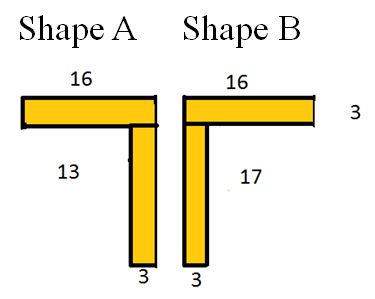
Divide each shape into two rectangles. To find the area of each shape, you will have to find the area of each rectangle and add them together.
Shape A:
- Find the area of the first rectangle:
- A = lw
- A = 3(16)
- A = 48
- Find the area of the second rectangle:
- A = lw
- A = 3(13)
- A = 39
- Add the first and second triangle together for the total area:
- Total Area = 48 + 39
- Total Area = 87
Shape B:
- Find the area of the light green rectangle:
- A = lw
- A = 3(16)
- A = 48
- Find the area of the blue square:
- A = lw
- A = 3(13)
- A = 39
- Add the first and second triangle together for the total area:
- Total Area = 48 + 39
- Total Area = 87
Add all of the areas together to get the total surface area:
48 + 39 + 60 + 9 + 51 + 9 + 87 +87 = 390
The total surface area of the three dimensional shape is 390.
Surface Area of a Cylinder
Let's find the surface area of the cylinder below.
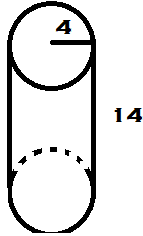
You will use the following formula to solve for the surface area: SA = 2πr2 + πdh
You will notice that the top and bottom are circles so part of the formula is 2 times the area of a circle. If you were to slice the rest of the cylinder open, it would be in the shape of a rectangle so part of your formula is for the area of a rectangle (lw) except we have to find the length by finding the circumference of the circle.
- Fill in all of the information you know into the formula.
SA = 2πr2 + πdh
SA = 2π(42) + π(8)(14) - Simplify the problem. It is acceptable to leave your answer in terms of pi unless you are told to do something else.
SA = 2π(42) + π(8)(14)
SA = 32π + 112π
SA = 144π
The surface area of this cylinder is 144π.
Surface Area of a Sphere
Let's find the surface area of the sphere below.
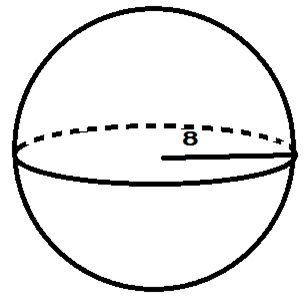
You will use the following formula to solve for the surface area: SA = 4πr2
- Fill in all of the information you know into the formula.
SA = 4πr2
SA = 4π(82) - Simplify the problem. It is acceptable to leave your answer in terms of pi unless you are told to do something else.
SA = 4π(82)
SA = 4π(64)
SA = 256π
The surface area of this sphere is 256π.
Surface Area of a Cone
Let's find the surface area of the cone below.
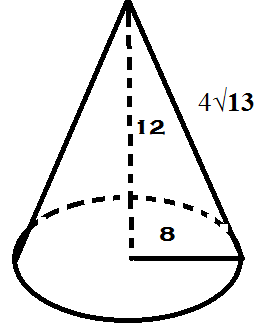
You will use the following formula to solve for the surface area: SA = πr2 + πrl
The first part of the formula finds the area of the base. In the second part of the equation, the l is for the slant height, which is 4√13 in this instance.
- Fill in all of the information you know into the formula.
SA = πr2 + πrl
SA = π(82) + π(8)(4√13) - Simplify the problem. It is acceptable to leave your answer in terms of pi unless you are told to do something else.
SA = π(82) + π(8)(4√13)
SA = 64π + 32√13π
The surface area of this cone is 64π + 32√13π.
Volume of Irregular Shapes
We can also find the volume of irregular shapes.
Our first step is to separate the shape into separate rectangular prisms.
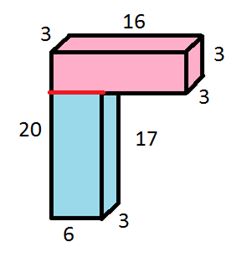
- Find the volume of the blue rectangular prism.
- V = lwh
- V = (6)(3)(17)
- V = 306
- Find the volume of the pink rectangular prism.
- V = lwh
- V = (16)(3)(3)
- V = 144
- You will add the volumes together to find the total volume.
- 306 + 144 = 450
The total volume of the shape is 450.
Volume of a Cylinder
Let's find the volume of the cylinder below. You will find the area of the base and then multiply it by the height.
You will use the following formula: V = πr2h
- Fill in all of the information you know into the formula.
V = πr2h
V = π(42)(14) - Simplify the problem. It is acceptable to leave your answer in terms of pi unless you are told to do something else.
V = π(42)(14)
V = π(16)(14)
V = 224π
The volume of this cylinder is 224π.
Volume of a Sphere
Let's find the volume of the sphere below.
You will use the following formula to find the volume: V = 4/3πr3
- Fill in all of the information you know into the formula.
V = 4/3πr3
V = 4/3π(83) - Simplify the problem. It is acceptable to leave your answer in terms of pi unless you are told to do something else.
V = 4/3π(83)
V = 4/3π(512)
V = 682 2/3 π
The volume of this sphere is 682 2/3 π.
Volume of a Cone
Let's find the volume of the cone below.
You will use the following formula to solve for the volume: V = 1/3 πr2h
- Fill in all of the information you know into the formula.
V = 1/3 πr2h
V = 1/3 π(82)(12) - Simplify the problem. It is acceptable to leave your answer in terms of pi unless you are told to do something else.
V = 1/3 π(82)(12)
V = 1/3 π(64)(12)
V = 256π
The volume of this cone is 256π.
Surface Area Knowledge Checks
Knowledge Check #1
- Find the total surface area of the following shape.
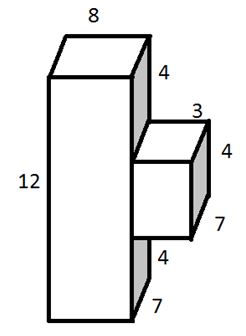
- How many faces does this shape have?
Answer: 12
- What is the total surface area?
Answer: 538
How to Solve:
(12)(8) = 96
(3)(7) = 21
(12)(8) = 96
(3)(7) = 21
(12)(7) = 84
(3)(4) = 12
(4)(7) = 28
(3)(4) = 12
(8)(7) = 56
(4)(7) = 28
(8)(7) = 56
(4)(7) = 28
- How many faces does this shape have?
Knowledge Check #2
- Find the total surface area of the following shape.
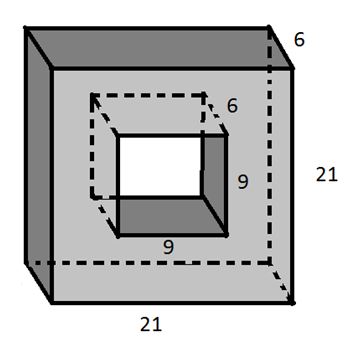
- How many faces does this shape have?
Answer: 10
- What is the total surface area?
Answer: 1,440
How to Solve:
Front and back: 2[(21)(21) – (9)(9)] = 720
Outside faces: 4[(6)(21)] = 504
Inside faces: 4[(6)(9)] = 216
720 + 504 + 216 = 1,440
- How many faces does this shape have?
Knowledge Check #3
- Find the total surface area of the following shape.
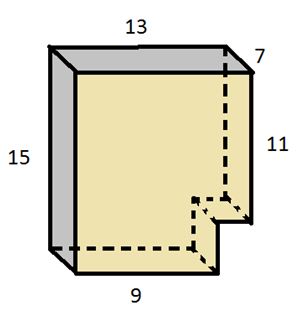
- How many faces does this shape have?
Answer: 8
- What is the total surface area?
Answer: 750
How to Solve:
Outside faces:
(15)(7) = 105
(11)(7) = 77
(13)(7) = 91
(9)(7) = 62
(4)(7) = 28
(4)(7) = 28
Front and back:
[(13)(11) + (9)(4)] = 358
105 + 77 + 91 + 62 + 28 + 28 + 358 = 750
- How many faces does this shape have?
Knowledge Check #4
- Find the total surface area of the following shape.
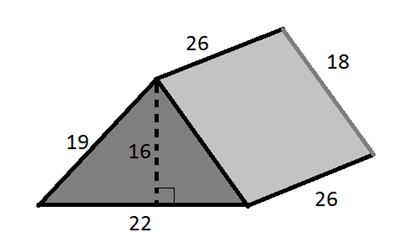
- How many faces does this shape have?
Answer: 5
- What is the total surface area?
Answer: 1,886
How to Solve:
A = ½ bh
A = ½ (22) 16
A = 176
A = ½ bh
A = ½ (22)(16)
A = 176
A = lw
A = (26)(18) = 468
A = lw
A = (26)(22) = 572
A = lw
A = (26)(19) = 494
176 + 176 + 468 + 572 + 494 = 1,886
- How many faces does this shape have?
Knowledge Check #5
- Find the total surface area of the following shape.
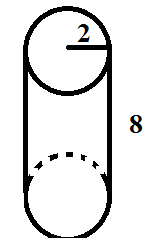
- What formula should you use?
Answer:SA = 2πr2 + πdh
- What is the total surface area?
Answer:40π
How to Solve:
SA = 2πr2 + πdh
SA = 2π(22) + π(4)(8)
SA = 2π(4) + π(4)(8)
SA = 8π + 32π
SA = 40π
- What formula should you use?
Knowledge Check #6
- Find the total surface area of the following shape.
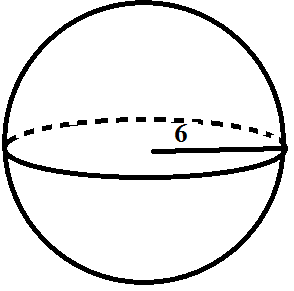
- What formula should you use?
Answer: SA = 4πr2
- What is the total surface area?
Answer: 144π
How to Solve:
SA = 4πr2
SA = 4π(62)
SA = 4π(36)
SA = 144π
- What formula should you use?
Knowledge Check #7
- Find the total surface area of the following shape.
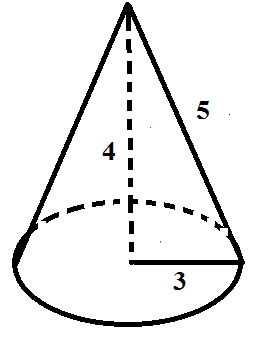
- What formula should you use?
Answer: SA = πr2 + πrl
- What is the total surface area?
Answer: 24π
How to Solve:
SA = πr2 + πrl
SA = π(32) + π(3)(5)
SA = π(9) + π(15)
SA = 24π
- What formula should you use?
Volume Practice
Knowledge Check #8
- Find the volume of the following shape.
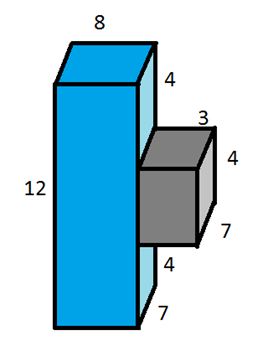
- How many rectangular prisms is this divided into?
Answer: 2
- What is the volume?
Answer: 756
How to Solve:
V = lwh
V = (7)(8)(12)
V = 672
V = lwh
V = (3)(4)(7)
V = 84
672 + 84 = 756
- How many rectangular prisms is this divided into?
Knowledge Check #9
- Find the volume of the following shape.
- How many rectangular prisms should you divide this into?
Hint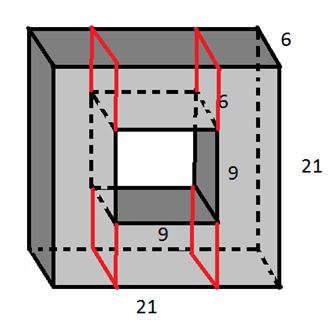
Answer: 4
- What is the total volume?
Answer: 2,160
How to Solve:
2[(6)(21)(6)] = 1,512
2[(6)(9)(6)] = 648
1,512 + 648 = 2,160 - There is another way to solve this problem.
Answer: You can also find the volume of the entire shape and then subtract the piece cut out of the center.
V = lwh
V = (21)(21)(6)
V = 2,646
V = lwh
V = (9)(9)(6)
V = 486
2,646 − 486 = 2,160
- How many rectangular prisms should you divide this into?
Knowledge Check #10
- Find the volume of the following shape.
- How many rectangular prisms should you divide this into?
Hint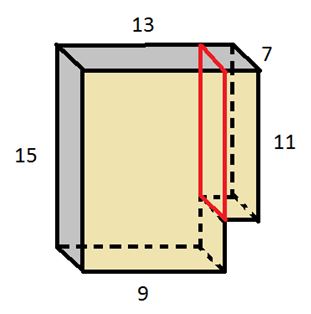
Answer: 2
- What is the volume?
Answer: 1,253
How to Solve:
V = lwh
V = (15)(9)(7)
V = 945
V = lwh
V = (4)(11)(7)
V = 308
945 + 308 = 1,253 - There is another way to solve this problem.
Answer: You can also find the total volume and subtract the piece that is missing from the corner.
V = lwh
V = (15)(13)(7)
V = 1,365
V = lwh
V = (4)(4)(7)
V = 112
1,365 − 112 = 1,253
- How many rectangular prisms should you divide this into?
Knowledge Check #11
- Find the volume of the following shape.
- What formula should you use?
Answer: V = πr2h
- What is the volume?
Answer: 32π
How to Solve:
V = πr2h
V = π(22)(8)
V = π(4)(8)
V = 32π
- What formula should you use?
Knowledge Check #12
- Find the volume of the following shape.
- What formula should you use?
Answer: V = 4/3 πr3
- What is the volume?
Answer: 288π
How to Solve:
V = 4/3 πr3
V = 4/3 π(63
V = 4/3 π(216)
V = 288π
- What formula should you use?
Knowledge Check #13
- Find the volume of the following shape.
- What formula should you use?
Answer: V = 1/3 πr2h
- What is the volume?
Answer: 12π
How to Solve:
V = 1/3 πr2h
V = 1/3 π(32)(4)
V = 1/3 π(9)(4)
V = 1/3 π(36)
V = 12π
- What formula should you use?