Oxygen Loading/Unloading Factors
Oxygen is carried through the blood to the tissues bound to hemoglobin molecules found in red blood cells. Hemoglobin (Hgb) molecules can carry 4 oxygen molecules at a time. (See Image 4 for an illustration of 4 oxygen molecules bound to a Hgb molecule). Oxygen is said to be "loading" onto the hemoglobin molecule as it attaches. It has a high affinity for Hgb until the molecule is saturated with 4 oxygen molecules. The oxygen molecules will "unload" from Hgb and diffuse into tissues.
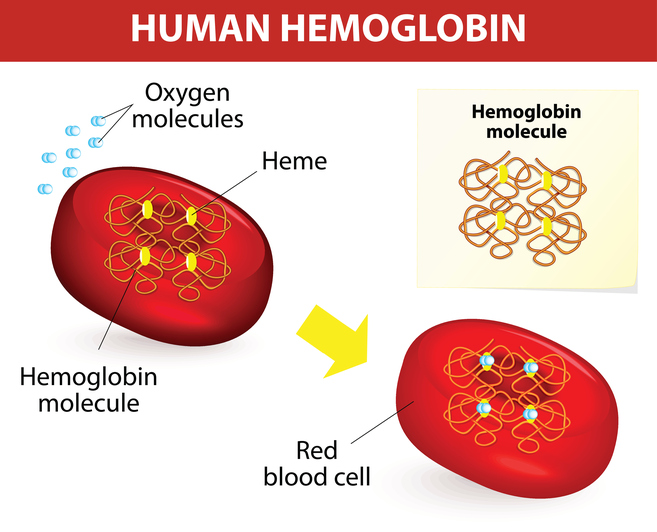
Image 4
Changes in temperature, pH, and CO2 levels affect oxygen loading and unloading:
Causes of a lower affinity for oxygen to hemoglobin, thus causing oxygen unloading from hemoglobin and diffusing into tissues.
- Increased temperatures
- decreased pH
- increased CO2 levels
The Bohr Effect
The Bohr Effect states that the lower the pH, the less affinity of oxygen to Hgb (or a lower binding capacity). This causes oxygen to dissociate from Hgb into the tissues.
 Check Your Understanding:
-Hgb is a molecule that can carry up to 4 ________ molecules.
-What occurs the higher the affinity Hgb has for oxygen?
-True or False?: The Bohr Effect would agree with this statement: "The normal pH in the blood is between 7.45-7.35. If it drops to 7.34, oxygen will have a higher affinity for Hgb and will not dissociate from it into the tissues."
-When the affinity lowers, what occurs with the oxygen bound to it?
-When you are sick and have a high fever, how would you describe the binding capacity of oxygen to Hgb?
-What will occur to the binding capacity of oxygen if your carbon dioxide levels are low?