Respiratory Cycle
The respiratory cycle is a repeated process involving breathing sometimes called ventilation is the movement of air in and out of the lungs and respiration exchange of gases driven by pressure and concentration changes. Air moves from areas of high pressure to low pressure, and so it goes with breathing. Air will move in and out of the lungs due to pressure differences inside the chest cavity compared to the pressure of the atmosphere outside the body.
Below is a description of this cycle broken up into the inhalation and exhalation phases.
Image 1
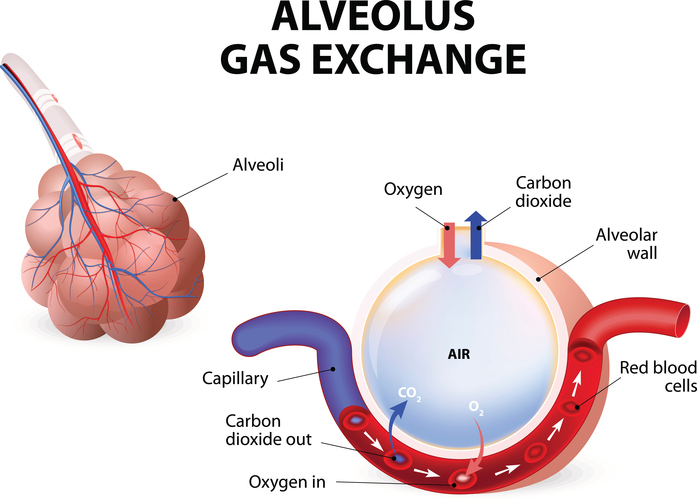
Image 2
Inhalation/Inspiration
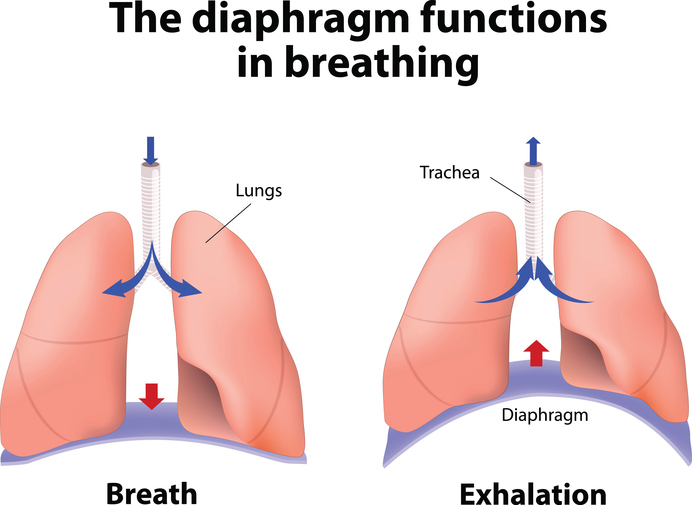
Inhalation/Inspiration (breathing in) is driven by the diaphragm contracting (moving inferiorly or downwards) and the rib cage expanding. (See Image 2 illustrating position changes of the diaphragm.)
- This results in a larger chest cavity volume which causes a lower thoracic cavity pressure as compared to the pressure outside of the body. Thus, air moves into the lungs.
- Oxygen taken in with the air will diffuse through the alveolar membranes into the capillaries where it is taken to the tissues and at the same time, carbon dioxide will diffuse in the opposite direction. (See Image 1 of the Alveoli and capillary level of gas exchange between oxygen and carbon dioxide.)
Exhalation/Expiration
Exhalation/Expiration (breathing out) occurs passively as the pressure in the thoracic cavity becomes higher than the pressure outside the body.
- The diaphragm will move upwards and air will be released. (See Image 2)
- Carbon dioxide is removed with exhalation.
 Check Your Understanding:
-Summarize the movement of the diaphragm during inhalation and exhalation.
-What causes air to passively move out of the lungs during exhalation?
-Ventilation is another word for ______.
-Where does the oxygen go from the alveoli?