Learn
Third Line of Defense
The third line of defense is called specific resistance. It is classified as adaptive immunity refers to antigen-specific immune response and as acquired immunity immunity arising from exposure to antigens . This system relies on antigens, which are specific substances found in foreign microbes, and antibodies. Most antigens are proteins that serve as the stimulus to produce an immune response. The term "antigen" comes from ANTI-body GENerating substances.
There are the steps in this immune response:
- When an antigen is detected by a macrophage, this causes the T-cells to become activated.
- The activation of T-cells by a specific antigen is called cell-mediated immunity (See Image 3). The body contains millions of different T-cells, each able to respond to one specific antigen.
- The T-cells secrete interleukin 2.
- Interleukin 2 causes the proliferation of certain cytotoxic T cells and B cells.
- The immune response then follows 2 paths:
- one path uses cytotoxic T cells and
- the other uses B cells.
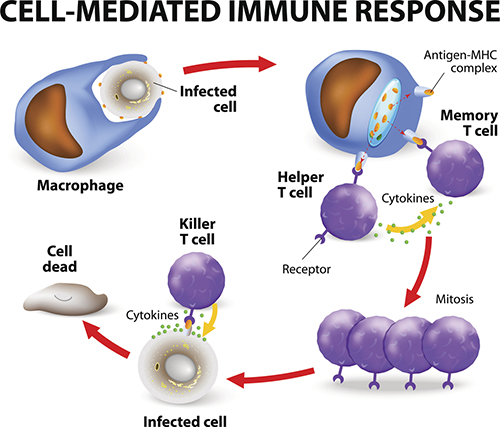
Image 3
 Check for understanding:
-Why is the 3rd line of defense considered to be an adaptive immune response?
-What is the correct order of the 3rd line of defense immune response activity from the list of actions below?
a. T-cells to become activated.
b. An antigen is detected by a macrophage
c. The immune response then follows 2 paths: uses cytotoxic T cells or uses B cells.
d. T-cells secrete interleukin 2 causing T cell and B cell proliferation.