Learn
Body Planes
A plane is an imaginary two-dimensional surface that passes through the body.
There are 3 planes commonly referred to in anatomy. (See Image 2)
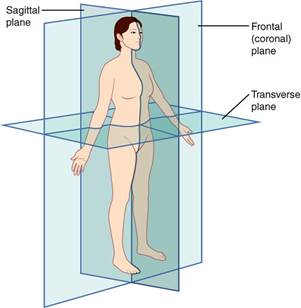
Image 2: Body Planes
- Sagittal plane - divides the body or an organ vertically into right and left sides.
- Midsagittal or median plane - divides the body into equal right and left sides.
- Parasagittal plane (or longitudinal section) – divides into unequal sides
- Frontal plane (or coronal plane) - divides the body or an organ into an anterior (front) portion and a posterior (rear) portion.
- Transverse plane (or horizontal) - divides the body or organ horizontally into upper and lower portions.
These planes are important in understanding the angle of view in a picture, x-ray, or other image of the body that has been taken. See more examples about body planes at Directions and Planes of Section.
Directional Terms
Directional terms describe anatomy by relative positions. See this list of terms and the illustration of the terms in Image 3.
- Anterior (or ventral) - the front or direction toward the front of the body
- Posterior (or dorsal) - the back or direction toward the back of the body
- Superior (or cranial) - a position above or higher than another part of the body proper
- Inferior (or caudal) - a position below or lower than another part of the body proper
- Lateral - direction toward the side of the body
- Medial - the middle or direction toward the middle of the body
- Proximal – a position nearer to the point of attachment or the trunk of the body
- Distal - a position in a limb that is farther from the point of attachment or the trunk of the body
- Superficial - a position closer to the surface of the body
- Deep - a position farther from the surface of the body
- Prone – body is face-down
- Supine – body is face-up
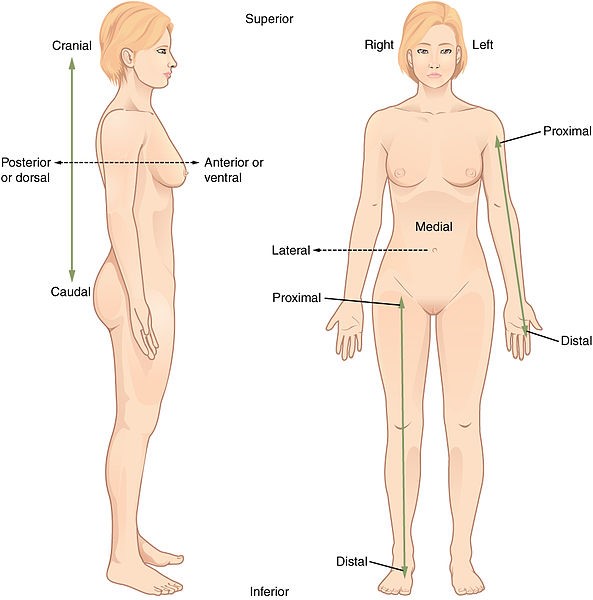 Image 3: Directional Terminology