Learn
Annual Percentage Yield
Annual percentage yield (APY) is often confused with annual percentage rate (APR). Annual percentage rate is the rate paid for the year without taking into consideration compounding. Annual percentage yield does take into consideration the compounding. When comparing banks, it is important to know the difference so that you are comparing the same thing.
Formula for APY
We can use the formula below to find annual percentage yield:
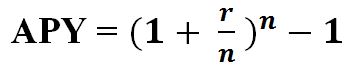
This is read “annual percentage yield is equal to one plus the annual rate divided by the number of periods it is compounded all raised to the number of periods it is compounded then reduced by one.”
This works for borrowed money as well as money put into interest bearing accounts. The periods of compounding can vary from semi-annual (2 times – every 6 months) to quarterly (4 times – every 3 months) to monthly (12 times – every month).
Example #1
You have money on a CD receiving an APR of 2% compounded monthly. You want to know what the APY is.

APY = (1 + 0.00166667)12 – 1
APY = (1.00166667)12 – 1
APY = 1.020184355681501– 1
APY = 0.020184355681505
With monthly compounding, your APY is approximately 2.02%
- You will need to round your answers to two decimal places.
Example #2
You have a loan at a rate of 8% compounded quarterly. What is the APY on this loan?

APY = (1 + 0.02)4 – 1
APY = (1.02)4 – 1
APY = 1.08243216 – 1
APY = 0.08243216
You are actually paying 8.24% on this loan when it is compounded quarterly.
Remember
- As the number of times interest is compounded increases, APY also increases.
- Keep in mind that your goal is to get the highest possible rate on money that you are receiving interest on and to pay the lowest possible rate on money that you have borrowed.