Solving Quadratic Equations by Factoring
What is a quadratic function?
Before we begin reviewing factoring, let us review what a quadratic function is:
3x2 + 2x - 1 = 0
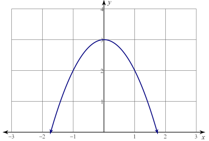
Quadratic Equations make nice curves, like this one. The curve of a quadratic function is called a parabola
.
Solving Quadratic Functions by Factoring
We will start by reviewing how to factor quadratic equations.
The equation x2 - 9 factors into (x + 3)(x - 3).
Do you remember this is a difference of squares?
a2 - b2 = (a + b)(a - b)
In Algebra I, the expression had to be a difference of squares to be able to factor it, because we only worked with real numbers.
Quadratic Equations with Real Roots
The graph of the equation f(x) = x2 - 9 is shown below.
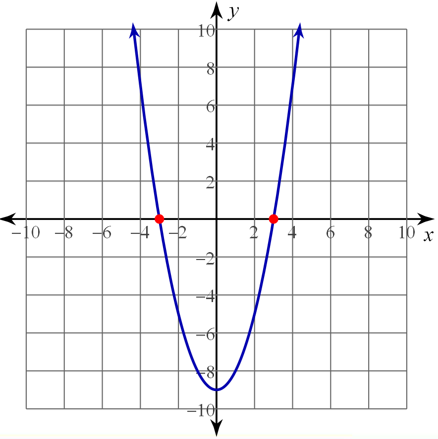
If the factors are (x - 3)(x + 3) then x = ± 3
You can see these are the x-intercepts of the graph. Since x is to the second power, you know we now have 2 solutions.
Quadratic Equations with Complex Roots
Since we have learned about complex numbers, we can now factor sum of squares. If we have an equation: x2 + 9 = 0, we can solve by taking the square root of both sides.
x2 = -9
√ x2 = √-9
x = ± 3i
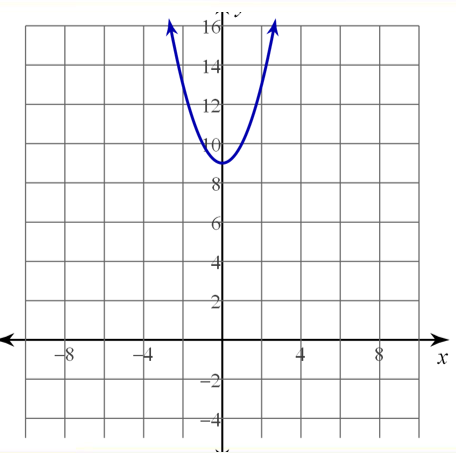
You can look at the graph to see there are not any x-intercepts. This graph will never cross through the x-axis. Since we do not have any real solutions, there are no x-intercepts on this parabola. Imaginary solutions are not x-intercepts on a graph.
Find the factors of x2 + 9 = 0.
Since we found that x = 3i or x = -3i for this problem, we can get everything to one side to find the factors.
x = 3i
Subtract 3i from both sides
x - 3i = 0
or
x = -3i
Add 3i to both sides.
x + 3i = 0
So, the factors would be (x + 3i)(x - 3i) = 0
Now, we can factor sum of squares with this formula: a2 + b2 = (a + bi)(a - bi)
Example #1
Factor and solve x2 + 36 = 0
Since this is a sum of squares, we can use the formula that we just learned:
a2 + b2 = (a + bi)(a - bi)
a = √x2 =
b = √36 =
Now, plug into the formula: (a + bi)(a - bi)
Remember to plug x in for a and 6 in for b.
( )( ) = 0
Now, set each factor equal to zero and solve.
x + 6i = 0
x =
x - 6i = 0
x =
Your solution is
Example #2
Factor and solve 8x2 + 50 = 0
Do not forget to always look for a greatest common factor first!
There is a GCF of 2. We will first factor out a 2:
2( + 25 ) = 0
Since this is a sum of squares, we can use the formula that we just learned:
a2 + b2 = (a + bi)(a - bi)
a = √4x2 =
b = √25 =
Now, plug into the formula: (a + bi)(a - bi)
Remember to plug 2x in for a and 5 for b.
( )( ) = 0
Now, set each factor equal to zero and solve.
2x + 5i = 0
2x =
2x - 5i = 0
2x =
Your solution is
Reviewing of Factoring Trinomials
Now, we will review factoring trinomials in the form ax2 + bx + c
First, find the factors of a times c that add to equal b. If the factors are p and q, then it will factor into: 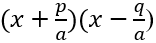
You will then reduce each fraction by "a", then move any remaining denominator to the front of the factor.
Example #3
Solve 3x2 + 14x + 8 = 0 by factoring.
Factors of ac = 24
Sum of b: Middle coefficient: 14
Select the factors that add to equal 14.
| Factors of 24 | Sum of 14 |
| 1, 24 | |
| 2, 12 | 2 + 12 = 14 |
| 3, 8 | |
| 4, 6 |
We found that the factors of ac that add to equal b are 2 and 12.
(x + 2)(x + 12)
Now, divide or reduce 12 and 2 by your "a" (a = 3)
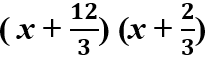
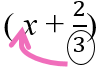
After you reduce, if there is a number left in the denominator, you will take it to the front of the factor.
(x +
)
(x + 4)( ) = 0
Now, set each factor equal to zero and solve.
x + 4 = 0
x =
3x + 2 = 0
3x =
x =
To check your work, plug your solutions back into the original problem.
x = -4
3x2 + 14x + 8 = 0
3(-4)2 + 14(-4)+ 8 = 0
3(16) + 14(-4) + 8 = 0
48 - 56 + 8 = 0
-8 + 8 = 0
0 = 0
This solution checks out.
x = 
3()2 + 14() + 8 = 0
3( ) + 14() + 8 = 0
 -
 + 8 = 0
 + 8 = 0
-8 + 8 = 0
0 = 0
This solution checks out.
Example #4
Factor and solve 5x2 - 17x + 14.
First, look for a GCF. There is not one, so now find the factors of "a" times "c" that add to equal "b".
Factors of ac: Multiply the first and last coefficients: 5(14) =
Sum of b: Middle Term b =
Select the factors that add to -17.
| Factors of +70 | Sum of -17 |
| -1, -70 | |
| -2, -35 | |
| -7, -10 | -10 + -7 = -17 |
We found the factors of ac that add to equal b are -7 and -10.
(x - 7)(x - 10)
Now, divide or reduce -7 and -10 by your "a" (a = 5)
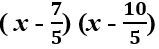
After you reduce, if there is a number left in the denominator, you will take it to the front of the factor.
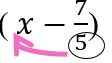 (x -
)
( )(x - 2) = 0
(x - 2)(5x - 7) = 0
Now set each factor equal to zero and solve.
x - 2 = 0
x =
5x - 7 = 0
5x =
x =
To check your work, plug your solutions back into the original problem:
x = 2
5x2 - 17x + 14 = 0
5(2)2 - 17(2) + 14 = 0
5(4) - 17(2) + 14 = 0
20 - 34 + 14 = 0
-14 + 14 = 0
0 = 0
This solution checks out.
x = 
5x2 - 17x + 14 = 0
5()2 - 17()+ 14 = 0
5( ) - 17() + 14 = 0
 -
 + 14 = 0
 + 14 = 0
-14 + 14 = 0
0 = 0
This solution checks out.
To factor trinomials of the form ax2 + bx + c = 0
1. Find the product of ac.
2. Find all possible factors of ac.
3. Determine which factors of ac sum to equal b. These will be p and q.
4. Substitute p and q into the formula
5. If p and q do not divide evenly by a, make a the coefficient of x in that factor.