Try It
Analyzing Quadratic Equations Review
Let's see what you know about discriminants.
- Given the graph of the function, determine if the discriminant is less than zero, equal to zero, or greater than zero.
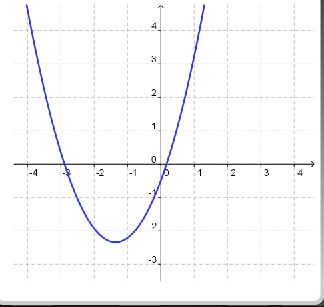
- D = 0
- D < 0
- D > 0
Answer: c. D > 0. The graph has two x intercepts, so it must have a discrimiant that is positive.
- Given x2 − 10x + 25, determine if the roots are real or imaginary.
- real and imaginary
- imaginary
- real
Answer: c. real. Since the discriminant is greater than or equation to zero, the root must be real.
- Given x2 − 2x + 1 = 0, determine the number of x-intercepts.
- 1
- 2
Answer: a. 1. Since the discriminant is equal to zero, there is one real double root.
- If the discriminant of an equation is 4, which of the following is true?
- there are 2 real roots
- there are 2 imaginary roots
Answer: b. there are 2 real roots. Because the discriminant is positive, there must be two real roots.
- Given −x2 − 3x − 5 = 0, determine if the roots are real or imaginary.
- imaginary
- real
Answer: b. imaginary. Since the discriminant is negative, the roots must be imaginary.
- Given the graph of the function, determine if the discriminant is less than zero, equal to zero, or greater than zero.
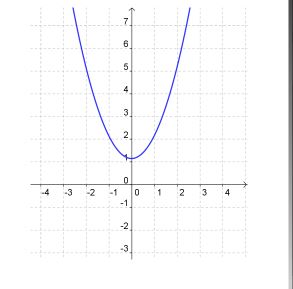
- D = 0
- D < 0
- D > 0
Answer: b. D < 0. The graph has 0 x-intercepts, so the discriminant must be less than zero.
- Given the graph of the function, determine if the discriminant is less than zero, equal to zero, or greater than zero.
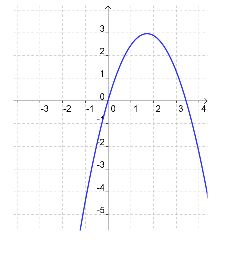
- D = 0
- D < 0
- D > 0
Answer: c. D > 0. The graph has two x-intercepts, so it must have a discriminant that is positive.
- If the discriminant of an equation is −3, which of the following is true?
- there are 2 real roots
- there are 2 imaginary roots
Answer: c. there are 2 imaginary roots. Since the dsicriminant is negative, there must be two imaginary roots.
- Given x2 + 3x − 1 = 0, determine the number of x-intercepts.
- 1
- 2
Answer: b. 2. Since the discriminant is positive, there are two real roots and 2 x-intercepts.
- Given the graph of the function, determine if the discriminant is less than zero, equal to zero, or greater than zero.
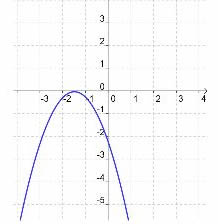
- D = 0
- D < 0
- D > 0
Answer: a. D = 0. The graph has 0 x-intercepts, so the discriminant must be less than zero.