Learn
Analyzing Quadratics
Analyzing Quadratic Equations
Remember the discriminant is the part of the quadratic formula under the radical. It discriminates between the types of solutions and the types of graphs for quadratic equations. We often call this the "nature" of the roots or solutions. Your nature is how you act and the nature of a quadratic equation is how it "acts".
Take Note!
Copy the information below into your study guide.
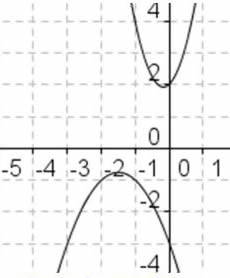
b2 − 4ac < 0
D < 0
There are 2 imaginary solutions.
There are 0 x intercepts
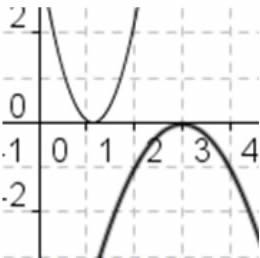
b2 − 4ac = 0
There is 1 double root.
There is 1 x intercept.
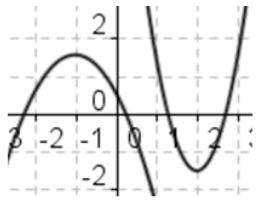
b2 − 4ac > 0
D > 0
There are two real roots.
There are 2 x intercepts.
Discriminant of the Quadratic Formula
The discriminant of the quadratic formula is the expression under the radical.
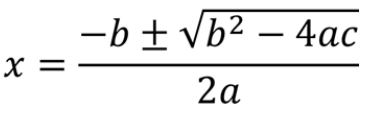
In this lesson, you will discover what the discriminant can tell you about the solutions to a quadratic function.
Solutions of a Quadratic Equation
There are three solution possibilities for a quadratic equation.
- The quadratic will have two real solutions.
- The quadratic will have only one real solution.
- The quadratic will have two imaginary solutions.
The discriminant of the quadratic formula will tell you which type of solution possibility you will have.
If b2 − 4ac > 0 Another way to think about this is if b2 − 4ac is a positive value. (i.e. any value greater than zero) , you will have two real solutions.
If b2 − 4ac = 0 If the value is equal to zero... , you will have only one real solution.
If b2 − 4ac < 0 Another way to think about this is if b2 − 4ac is a negative value. (i.e. any value less than zero) , you will have two imaginary solutions.
x-intercepts of a Quadratic
Remember that solutions and x-intercepts are the same thing. The solutions to a quadratic equation are the points of intersection with the x-axis. Therefore, you can expand the previous rules to be:
If b2 − 4ac > 0, you will have two real solutions and two x-intercepts.
If b2 − 4ac = 0, you will have only one real solution and one x-intercept.
If b2 − 4ac < 0, you will have no real solutions and no x-intercepts.
Example #1
Give the discriminant and predict the nature of the roots for the quadratic equations below.
Start by finding the values for a, b, and c from the equation.
−4x2 + 3x − 1 = 0
a=__blank
b=__blank
c=__blank
Answer:
a = −4
b =3
c = −1
2x2 −6x − 2 = 0
a = __blank
b = __blank
c = __blank
Answer:
a = 2
b = −6
c = −3
Now, substitute those values into the equation for the discriminant and solve.
−4x2 + 3x − 1 = 0
a = −4
b = 3
c = −1
D =b2 − 4ac
D =(__blank)2 − 4(__blank)(__blank)
D = __blank − __blank
D = (__blank)
Answer:
D =b2 − 4ac
D =(3)2 − 4(−4)(−1)
D = 9 − 16
D = −7
2x2 − 6x − 2 = 0
a = 2
b = −6
c = −2
D =b2 − 4ac
D =(__blank)2 − 4(__blank)(__blank)
D = __blank + __blank
D = (__blank)
Answer:
D = b2 − 4ac
D =(−6)2 − 4(2)(−2)
D = 36 + 16
D = 52
−4x2 + 3x − 1 = 0
a = −4, b = 3, c = −1
D = −7
Which best describes D? ___blankblankblank___blankblank
How many x-intercepts? ___blankblank
How many roots? ___blankblank
Real or imaginary roots? ___blankblank___blankblank___blankblank_
Answer: D < 0, 0, 2, imaginary
2x2 − 6x − 2 = 0
a = 2, b = −6, c = −2
D = 52
Which best describes D? ___blankblank___blankblank
How many x-intercepts? ___blankblank
How many roots? ___blankblank
Real or imaginary roots? ___blankblank___blankblank___blankblank_
Answer: D > 0, 2, 2, real
Example #2
Determine the value of the discriminant and state the number and type of solutions for 4x2 − 2x + 1 = 0
The formula for the discriminant is b2 − 4ac. What are the values of a, b, and c?
a = ___blankblank, b = ___blankblank, c = ___blankblank
Answer: 4, −2, 1
Evaluate the discriminant for:
a = 4, b = −2, c = 1
b2 − 4ac
( ___blankblank )2 − 4( ___blankblank ) ( ___blankblank )
Answer: (−2)2 − 4(4)(1)
Simplify your expression.
___blankblank − ___blankblank
Answer: 4 − 16
___blankblank
Answer: −12
The value of the discriminant is −12.
How many solutions will the quadratic have?
- 0
- 1
- 2
Answer: 2
How many x-intercepts will the quadratic have?
- 0
- 1
- 2
Answer: 0
Will the solutions be real or imaginary?
- Real
- Imaginary
Answer: Imaginary; Because the discriminant is −12, the quadratic will have no (zero) real solutions.
Example #3
Determine the value of the discriminant and state the number and type of solutions for x2 + 5x − 3 = 0
The formula for the discriminant is b2 − 4ac. What are the values of a, b, and c?
a = ___blankblank, b = ___blankblank, c = ___blankblank
Answer: 1, 5, −3
Evaluate the discriminant for:
a = 1, b = 5, c = −3
b2 − 4ac
( ___blankblank )2 − 4( ___blankblank ) ( ___blankblank )
Answer: (5)2 − 4(1)(−3)
Simplify your expression.
___blankblank − ___blankblank
Answer: 25 − 12
___blankblank
Answer: 37
The value of the discriminant is 37.
How many solutions will the quadratic have?
- 0
- 1
- 2
Answer: 2, Because the value of the discriminant is greater than 0, or b2 − 4ac > 0 you will have two real solutions.
How many x-intercepts will the quadratic equations have?
- 0
- 1
- 2
Answer: 2, Because the value of the discriminant is greater than 0, or b2 − 4ac > 0 you will have two x-intercepts.
Will the solutions are real or imaginary?
- Real
- Imaginary
Answer: Imaginary