Learn

The Formula

The Quadratic Formula

The quadratic formula can be used to solve any quadratic equation. To solve the equation, you will always want your equation in standard form, ax2 + bx + c = 0. Notice the right side of the equation must be zero. a, b, and c each represent real numbers.

The quadratic formula is: x equals the fraction with numerator negative b plus or minus the square root of b squared minus 4 a c and denominator 2 a

Identifying Values

It is important to identify the values for a, b, and c in order to use the quadratic formula.

Recall that a, b, and c represent the coefficients and constant of a quadratic equation.

For example, 4x2 − 6x + 3 = 0

a = 4
b = −6
c = 3

Example #1

Identify the values for a, b, and c using the quadratic equation 2x2 + 5x − 5 = 0.

a =
b =
c =

Example #2

Identify the values for a, b, and c using the quadratic equation −8x2 − 9x − 1 = 0.

a =
b =
c =

Substituting in the Formula

When substituting the values for a, b, and c into the quadratic formula, it is suggested to use parentheses so you will substitute the correct values.

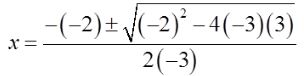
Suppose you had the expression −3x2 − 2x + 3. a = −3, b = −2, and c = 3. Substitute these values into the quadratic formula:
x equals the fraction with numerator negative b plus or minus the square root of b squared minus 4 a c and denominator 2 a

x equals the fraction with numerator negative negative 2 plus or minus the square root of open paren negative 2 close paren squared minus 4 times negative 3 times 3 and denominator 2 times negative 3

Hint: When substituting the negative value, remember to write the sign inside the parentheses. In this example, b = −2. When you substitute for the first b of the formula, don't forget the negative. So, you will have −(−2) for the first substitution.

Example #3

Practice substituting into the quadratic formula using the quadratic equation: 5x2 − 7x + 3 = 0.
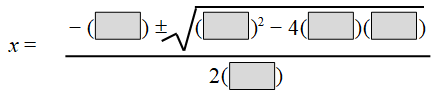
x equals the fraction with numerator negative b plus or minus the square root of b squared minus 4 a c and denominator 2 a

x equals the fraction with the numerator negative blank plus or minus the square root of blank squared minus four times blank times blank and denominator two times blank

Example #4

Practice substituting into the quadratic formula using the quadratic equation: −9x2 + 4x − 6 = 0.

x equals the fraction with numerator negative b plus or minus the square root of b squared minus 4 a c and denominator 2 a

x equals the fraction with the numerator negative blank plus or minus the square root of blank squared minus four times blank times blank and denominator two times blank

Simplify

Simplifying the Quadratic Formula

Now that you know how to substitute into the quadratic formula, it is time to learn how to simplify the formula.

Example #5

Open Solve Quadratic Equations Using the Quadratic Formula. in a new tab

Example #6

Open Solve Quadratic Equations Using the Quadratic Formula. in a new tab

Example #7

Solve the quadratic function x2 + 7x + 3 = 0 using the quadratic formula.

a =
b =
c =

Using the values a = 1, b = 7, and c = 3, fill-in the formula.

x equals the fraction with numerator negative b plus or minus the square root of b squared minus 4 a c and denominator 2 a

x equals the fraction with numerator negative 7 plus or minus the square root of 7 squared minus 4 times 1 times 3 and denominator 2 times 1

Simplify the first b term and the squared term. You can also simplify the denominator.
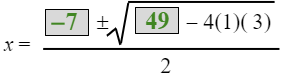
x equals the fraction with numerator negative 7 plus or minus the square root of 49 minus 4 times 1 times 3 and denominator 2

Simplify the multiplication under the radical.
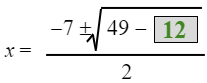
x equals the fraction with numerator negative 7 plus or minus the square root of 49 minus 12 and denominator 2

Simplify the subtraction under the radical.

x equals the fraction with numerator negative 7 plus or minus the square root of 37 and denominator 2

Simplify the square root by finding a decimal.
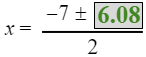
x equals the fraction with numerator negative 7 plus or minus the square root of 6.08 and denominator 2

Separate the two parts of the equation and solve. Simplify the numerators.

Part 1:

  • x equals the fraction with numerator negative 7 plus 6.08 and denominator 2
  • x equals the fraction with numerator negative 0.92 and denominator 2
  • x = −0.46

Part 2:

  • x equals the fraction with numerator negative 7 minus 6.08 and denominator 2
  • x equals negative 13.08 over 2
  • x = −6.54

The two solutions are x = −0.46 and x = −6.54 for the quadratic equation.

Remember that you can easily check your answer by substituting these values into the original question. This is always a good step to do so you will know your answer is correct.

Common Mistakes

As you probably have noticed, the quadratic formula is quite an intricate formula. There are a few common mistakes students tend to make when working with this formula.

Let's explore these potential mistakes to help in your solving.

Common Mistakes #1

The first common mistake is not properly substituting for the b value. Suppose you have 6x2 − 3x + 10 = 0. In this equation a = 6, b = −3, and c = 10.

Correct Substitution
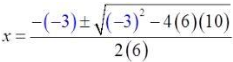
x equals the fraction with numerator negative negative 3 plus or minus the square root of open paren negative 3 close paren squared minus 4 times 6 times 10 and denominator 2 times 6

Incorrect Substitution

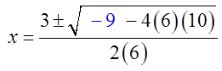
x equals the fraction with numerator negative 3 plus or minus the square root of negative 3 squared minus 4 times 6 times 10 and denominator 2 times 6

Common Mistakes #2

Another common mistake is not dividing the entire expression by 2a. Suppose you have 6x2 − 3x + 10 = 0. In this equation a = 6, b = −3, and c = 10.

Correct Substitution
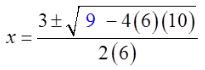
x equals the fraction with numerator negative negative 3 plus or minus the square root of open paren negative 3 close paren squared minus 4 times 6 times 10 and denominator 2 times 6

Incorrect Substitution

x equals negative negative 3 plus or minus the fraction with numerator the square root of open paren negative 3 close paren squared minus 4 times 6 times 10 and denominator 2 times 6

Common Mistakes #3

Another common mistake is not correctly squaring the b term under the radical. Suppose you have 6x2 − 3x + 10 = 0. In this equation a = 6, b = −3, and c = 10.

Correct Substitution

x equals the fraction with numerator negative negative 3 plus or minus the square root of open paren negative 3 close paren squared minus 4 times 6 times 10 and denominator 2 times 6

x equals the fraction with numerator 3 plus or minus the square root of 9 minus 4 times 6 times 10 and denominator 2 times 6

Incorrect Substitution

x equals the fraction with numerator negative negative 3 plus or minus the square root of negative 3 squared minus 4 times 6 times 10 and denominator 2 times 6

x equals the fraction with numerator 3 plus or minus the square root of negative 9 minus 4 times 6 times 10 and denominator 2 times 6

Example #8

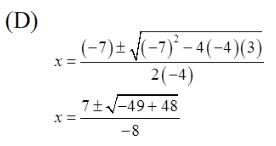
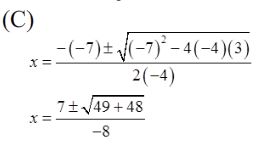
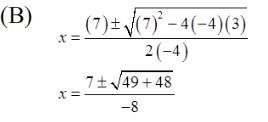
Using the quadratic equation −4x2 − 7x + 3 = 0, which of the following is properly substituted and squared?
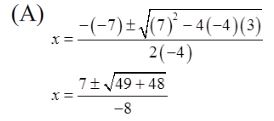
  • Box A. Two equations. First equation: x equals the fraction with numerator negative negative 7 plus or minus the square root of 7 squared minus 4 times negative 4 times 3 and denominator 2 times negative 4. Second equation: x equals the fraction with numerator 7 plus or minus the square root of 49 plus 48 and denominator negative 8
  • Box B. Two equations. First equation: x equals the fraction with numerator 7 plus or minus the square root of 7 squared minus 4 times negative 4 times 3 and denominator 2 times negative 4. Second equation: x equals the fraction with numerator 7 plus or minus the square root of 49 plus 48 and denominator negative 8
  • Box C. Two equations. First equation: x equals the fraction with numerator negative negative 7 plus or minus the square root of negative 7 squared minus 4 times negative 4 times 3 and denominator 2 times negative 4. Second equation: x equals the fraction with numerator 7 plus or minus the square root of 49 plus 48 and denominator negative 8
  • Box C. Two equations. First equation: x equals the fraction with numerator negative 7 plus or minus the square root of negative 7 squared minus 4 times negative 4 times 3 and denominator 2 times negative 4. Second equation: x equals the fraction with numerator 7 plus or minus the square root of 49 plus 48 and denominator negative 8

Answer: Box C. Two equations. First equation: x equals the fraction with numerator negative negative 7 plus or minus the square root of negative 7 squared minus 4 times negative 4 times 3 and denominator 2 times negative 4. Second equation: x equals the fraction with numerator 7 plus or minus the square root of 49 plus 48 and denominator negative 8

Complex Solutions

Example #9

Solve 2x2 + 5x + 5 = 1 by using the quadratic formula.

Step 1:

  • Get everything on the same side. Subtract 1 from both sides.
  • Subtract 1 from both sides. you got 2 x squared plus 5 x plus 4 equals 0

Step 2:

  • Identify the a, b, and c and plug into the formula.

a =
b =
c =

x equals the fraction with numerator negative b plus or minus the square root of b squared minus 4 a. c and denominator 2 a.

x equals the fraction with numerator negative 5 plus or minus the square root of 5 squared minus 4 times 2 times 4 and denominator 2 times 2

Step 3:

  • Simplify:
  • x equals the fraction with numerator negative 5 plus or minus the square root of 25 minus 32 and denominator 4
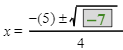
  • x equals the fraction with numerator negative 5 plus or minus the square root of negative 7 and denominator 4

Remember, when you take the square root of a negative number, you get an i.
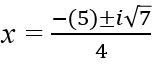
x equals the fraction with numerator negative 5 plus or minus i the square root of 7 and denominator 4

We will not have decimal answers since there is an i in the answer. Remember, if we have a complex solutions, there will not be any x-intercepts on the graph. The graph will never cross the x-axis.

Example #10

Solve −11x2 + 6x − 1 = 2 by using the quadratic formula.

Step 1:

  • Get everything on the same side. Subtract 2 from both sides.
  • Subtract 2 from both sides. You got negative 11 x squared plus 6 x minus 3 equals 0

Step 2:

  • Identify the a, b, and c and plug into the formula.

a =
b =
c =
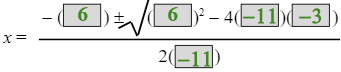
x equals the fraction with numerator negative b plus or minus the square root of b squared minus 4 a c and denominator 2 a

x equals the fraction with numerator negative 6 plus or minus 6 squared minus 4 times negative 11 times negative 3 and denominator 2 times negative 11

Step 3:

  • Simplify:
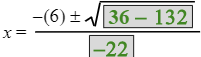
  • x equals the fraction with numerator negative 6 plus or minus the square root of open bracket 36 minus 132 close bracket and denominator the square root of negative 22
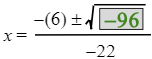
  • x equals the fraction with numerator negative 6 plus or minus the square root of negative 96 and denominator negative 22

Remember, when you take the square root of a negative number, you get an i.
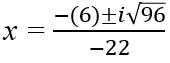
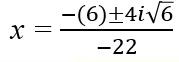
x equals the fraction with numerator negative 6 plus or minus i times the square root of 96 and denominator negative 22

In this problem, we can break down and simplify the square root of 96.

the square root of 96 equals the square root of 6 times 16 equals 4 the square root of 6

x equals the fraction with numerator negative 6 plus or minus 4 i the square root of 6 and denominator 22

If all numbers (not including the number in the radical) can reduce by a number, then we can reduce. If only 1 number on top can reduce with the denominator, then you cannot reduce the fraction! −6, 4, and 22 can reduce by 2.
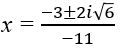
x equals the fraction with numerator negative 3 plus or minus 2 i the square root of 6 and denominator negative 11